


Welcome to Off the Clock — where we step away from the urgent and indulge the enduring.
Every other Saturday, I send a private note to subscribers exploring the curious corners of language, history, and the words we think we know—but don’t.
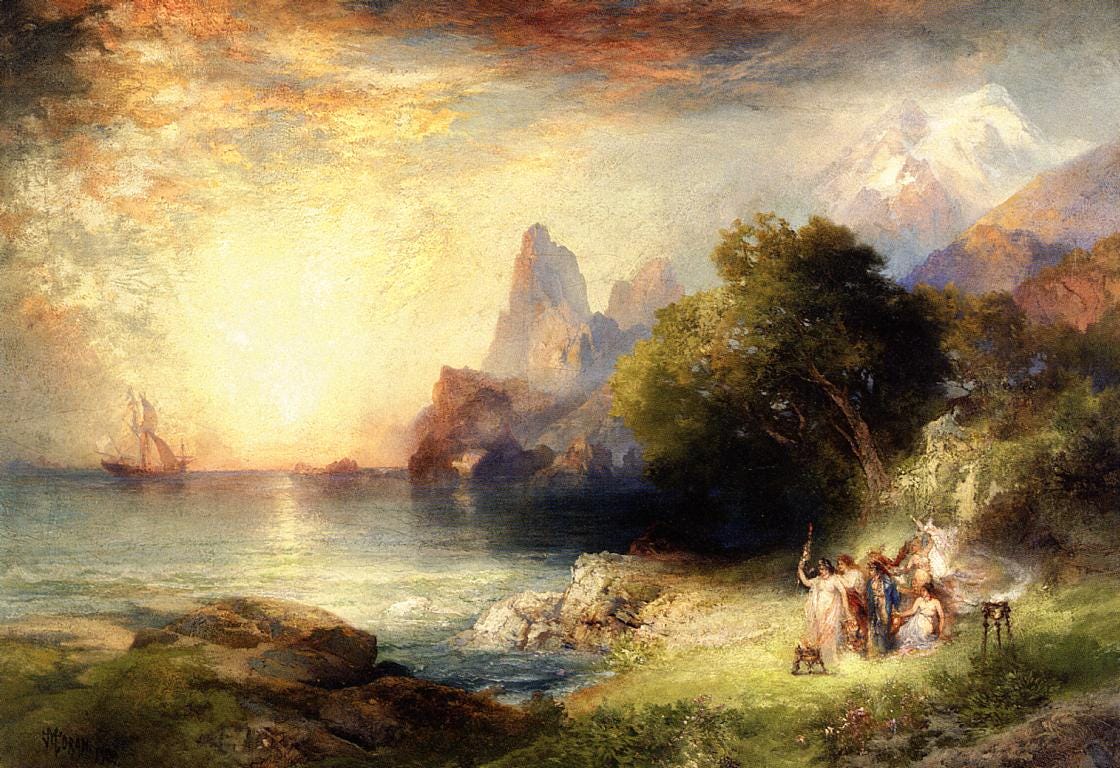
“Chanted from an ill-used race of men that cleave the soil,
Sow the seed, and reap the harvest with enduring toil”
— Alfred, Lord Tennyson, 1832
One of the things I love about history is how themes of the past keep repeating, but bear different interpretations based on matters of the present. Much the same can be said about our language as well.
Hence, Off the Clock.
In a previous edition, I took you “Between the Devil and the Deep Blue Sea,” where you encountered Sirens, a blinded Cyclops, and the strait between Scylla and Charybdis — in a poignant reminder about leadership and looking out for your people.

But more than lessons in human nature, Homer’s Odyssey left us with a forever changed vocabulary. Words from 3,000 years ago have crept into our modern vocabulary over time.
Let’s take a trip to oînops póntos, or the wine-dark sea, as Homer called it, and explore some terms from the Odyssey that made it home with him.

Odyssey
First, the name of the work itself. In its time, it was known as Odysseia — simply “the story of Odysseus.” At some point, the hero’s name became synonymous with a long, eventful and hard-won journey. A family trip, a parking battle, a drawn-out shopping excursion may each be an odyssey of sorts.
Siren
In Book 12 of the epic poem, we find Odysseus recalling how he commanded his crew to tie him to the mast and plug their ears with wax, lest they be lured to the rocky shores where the Sirens sang their beautiful song. A “siren song“ is anything of beauty luring you toward danger, and of course a siren itself is a loud warning device that commands your attention.
Mentor
This is one of the most interesting and enduring words (to me, at least). Mentor is an old friend of Odysseus, left behind to watch over the household. He became a more well-known figure thanks to the 1699 novel The Adventures of Telemachus, Son of Ulysses, in which we was a central character.
The popularity of that book gave rise to the use of mentor as a noun that meant anyone who guides someone less experienced than themselves. And over time, we began using it as a verb for the same purpose.
Tantalize
In “How Much Is Enough?“, we explored the legend of Tantalus, a figure Odysseus encountered in Hades. The king forever reached for fruit that rose out of his grasp and sought water that receded when he bent to drink — a cycle of infinite torture that was meted out as a punishment for revealing the secrets of the gods.
In Victorian times, there was a decanter rack called a tantalus, designed to lock up alcoholic spirits (ostensibly so the servants couldn’t enjoy a tipple when the employers weren’t around). And you’ll recognize the associated word tantalize, which signifies something that is tempting but out of reach.
Nerdy related podcast:

🔒 The rest of this post is for members of the Ampersand Guild, our community of like-minded people who are interested in learning more about the world and ourselves, every week. Below you’ll find a word that barely belongs on this list, two words that trace back to forbidden gardens, and a book that takes you to the sea Odysseus knew.

Such are a few of the many influences of thousands of lines of verse in 24 books that chronicle a long journey home. Each one of these represented some kind of challenge, obstacle, or temptation of mythical people — but represent real human struggles just the same.
And they’re still with us, nearly 3,000 years later, doing honorable work in our language today.
There’s so much to learn,
Related Reading
The Christopher Nolan film has spurred great interest in the subject, and there are two books worth picking up. The first is Emily Wilson’s modern translation of The Odyssey, published in 2017 and hailed as “a vital Odyssey for the twenty-first century that brings into rhythmic English the power, dignity, variety, and immediacy of this great poem.”
The second is her latest book, Crossing the Wine-Dark Sea: Journeys Through Ancient Literature, called “joyful, illuminating, and engrossing.”