Between the Devil and the Deep Blue Sea
The unknown can terrorize, but it can also inspire
Read the related edition:
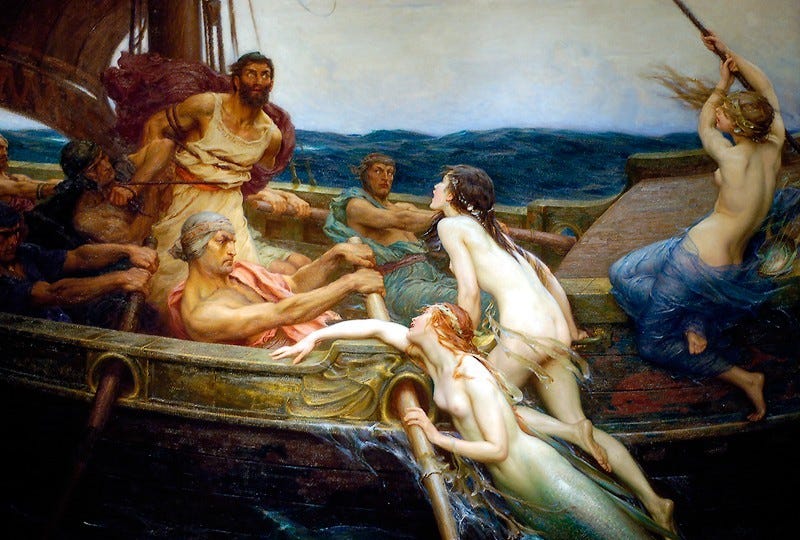
#/media/File:Ulysses_and_the_Sirens_by_H.J._Draper.jpg)
“Of all objects that I have ever seen, there is none which affects my imagination so much as the sea or ocean. A troubled ocean, to a man who sails upon it, is, I think, the biggest object that he can see in motion, and consequently gives his imagination one of the highest kinds of pleasure that can arise from greatness.”
— Joseph Addison, 1712
There is a certain power and majesty of the sea.
As I was staring at the ocean from my balcony last week, I mused about the lure of the ever-present oceans, as they make up more than 70 percent of the Earth's surface.
The vast expanse of the sea has been the source for the imagination of writers and leaders for millennia.
It has fueled our hopes, desires, and fears and driven us to explore, expand, and exploit.
We’re drawn to it and mesmerized by its size and strength. It fills us with thoughts of wonder and awe. Of power and possibilities. Of terror and delight.
In some ways, the sea is a metaphor for the modern multinational enterprise.

“The legislator is like the navigator of a ship on the high seas. He can steer the vessel on which he sails, but he cannot alter its construction, raise the wind, or stop the waves from swelling beneath his feet.”
—Alexis de Tocqueville, 1835
It is the leader rather than de Toqueville’s legislator that is the navigator for organizations. Leaders are powerless to control the actions of markets, competitors, and even customers themselves.
But they can provide guidance, clarity, and encouragement for the crew along for the journey.
Think about Odysseus, responsible for guiding his crew home following the Trojan War. The war itself lasted 10 years; the treacherous journey home doubled that, as there were all sorts of dangers along the way that delayed them.
Of course, Odysseus himself was the cause of some of the delay, as he taunted the cyclops Polyphemus after blinding him:
“Cyclops! If any mortal asks you how
Your eye was mutilated and made blind,
Say that Odysseus, the city-saker,
Laertes’ son, who lives in Ithaca,
Destroyed your sight.”
In his abrogation of humility, filled with such hubris that he felt the need to reveal his identity, Odysseus failed to realize that Polyphemus’ father was Poseidon. That’s right. The god of the sea.
You probably don’t want to be responsible for blinding the son of the god of the sea if — stay with me on this one — you’re making the journey home via the sea.
To make up for his error, Odysseus went to great lengths to protect his men on the remainder of the journey.
“Life at sea is of necessity the being controlled by others, by the captain of the ship or the regulation of the watch, by the motion of the waves and the direction of the wind.”
— Lewis H. Lapham, 2013
One of the dangers along the way was the call of the Sirens, who lured sailors toward the coast with their beautiful songs, wrecking their ships on the rocky shores.
Odysseus wanted to keep his men from this fate yet still needed to command the ship, so he stopped up their ears with beeswax and commanded them to tie him to the mast of the ship:
“They bound me hand and foot in the tight ship—
erect at the mast block, lashed by ropes to the mast—
and rowed and churned the whitecaps stroke on stroke.
We were just offshore as far as a man’s shout can carry,
scudding close, when the Sirens sensed at once a ship
was racing past and burst into their high, thrilling song!”
No sooner did they manage to successfully pass the island of the Sirens than they found themselves approaching the narrow strait between the gigantic rocks Scylla and Charybdis. The constant beating of the waves and current threatened to dash the ship against these legendary rocks.
Not to be outdone, Odysseus provided the moral guidance and encouragement his crew so needed at this moment, encouraging them to work together:
“Friends, we’re hardly strangers at meeting danger—
and this danger is no worse than what we faced
when Cyclops penned us up in his vaulted cave
with crushing force! But even from there my courage,
my presence of mind and tactics saved us all,
and we will live to remember this someday,
I have no doubt. Up now, follow my orders,
all of us work as one! You men at the thwarts—
lay on with your oars and strike the heaving swells,
trusting that Zeus will pull us through these straits alive.
You, helmsman, here’s your order—burn it in your mind—
the steering oar of our rolling ship is in your hands.
Keep her clear of that smoke and surging breakers,
head for those crags or she’ll catch you off guard,
she’ll yaw over there—you’ll plunge us all in ruin!”
Talk about motivational speakers…
Hey, did you know that I speak in front of groups about the Working TogetherTM Leadership & Management System? I share stories about my time at Ford with legendary CEO Alan Mulally and discuss how leading with love, humility, authenticity, data, and honesty can drive Profitable Growth for All.

“Anyone can hold the helm while the sea is calm.”
— Publilius Syrus, c. 30 BC
The great unknown—the wide expanse of business that presents itself to us every day—can be daunting to your team.
What will put their confidence and trust in you is someone who can provide a sense of order, a shared culture, and a commitment to working together.
Because the forces out there are stronger than any single one of us.

“The wonderful sea charmed me from the first.” — Joshua Slocum, 1900
I.
This may seem like an odd suggestion, but you may find it soothing to watch historic shipwreck videos on YouTube. (Vox)
(Note: some video links are broken; you may need to search YouTube to find them.)
II.
For centuries, humans have been fascinated with creatures like the giant squid. It forms the basis of legends like the kraken. But did you ever wonder why deep sea creatures get so oddly gigantic? Scientists may have the answer. (JSTOR)
III.
The deep sea contains many mysteries—mysteries that we may never solve. But that isn’t stopping scientists from reviving 100 million year-old microbes that may hold the secrets of ancient life. (Wired)

“Alone, alone, all, all alone, / Alone on a wide, wide sea!” — Samuel Taylor Coleridge, 1798
I.
The power of the sea brings to mind the power that comes with titles and appointments. Power doesn’t necessarily corrupt, but it does reveal. Why Power Brings Out Your True Self. (Nautilus)
II.
The danger of the sea, the strain of solitude: both are on display in Around Alone, chronicling the challenge of the world's first solo, nonstop, around-the-world yacht race. (Lapham's Quarterly)
III.
Did you ever wonder what your neighborhood looked like before you arrived? This smart map lets you plug in your address to see how your neighborhood has changed over time. Over the last 750 million years, that is. (Smithsonian)

“I’ve been bathing in the poem
Of star-infused and milky sea
Devouring the azure greens.” — Arthur Rimbaud, 1871
🎧 The Daily's Sunday Read: 'Alone at Sea' goes on a journey with 70 year-old Aleksander Doba, who kayaked across the Atlantic Ocean for a third time. But this time he did it solo. It is a deep dive into the physical and mental challenges of taking on the sea and being alone for over 110 days.

📚 In 1820, the whaleship Essex was rammed and sunk by an angry sperm whale, leaving the desperate crew to drift for more than ninety days in three tiny boats. In the Heart of the Sea by Nathaniel Philbrick was based on a long-lost written account by cabin boy Thomas Nickerson and the published account of first mate Owen Chase, along with vivid details about the Nantucket whaling tradition. They reveal the chilling facts of the infamous maritime disaster that was the basis for Moby-Dick.

There’s so much to learn,