

Old Thoughts for Christmas
Kindness, surprise, generosity, slowing down to savor life, and the triumph of love and hope over hardship

In the spirit of the holiday season, I’ve lifted the paywall on this entry of Off the Clock. I’d encourage you to join so you don’t miss the next one.
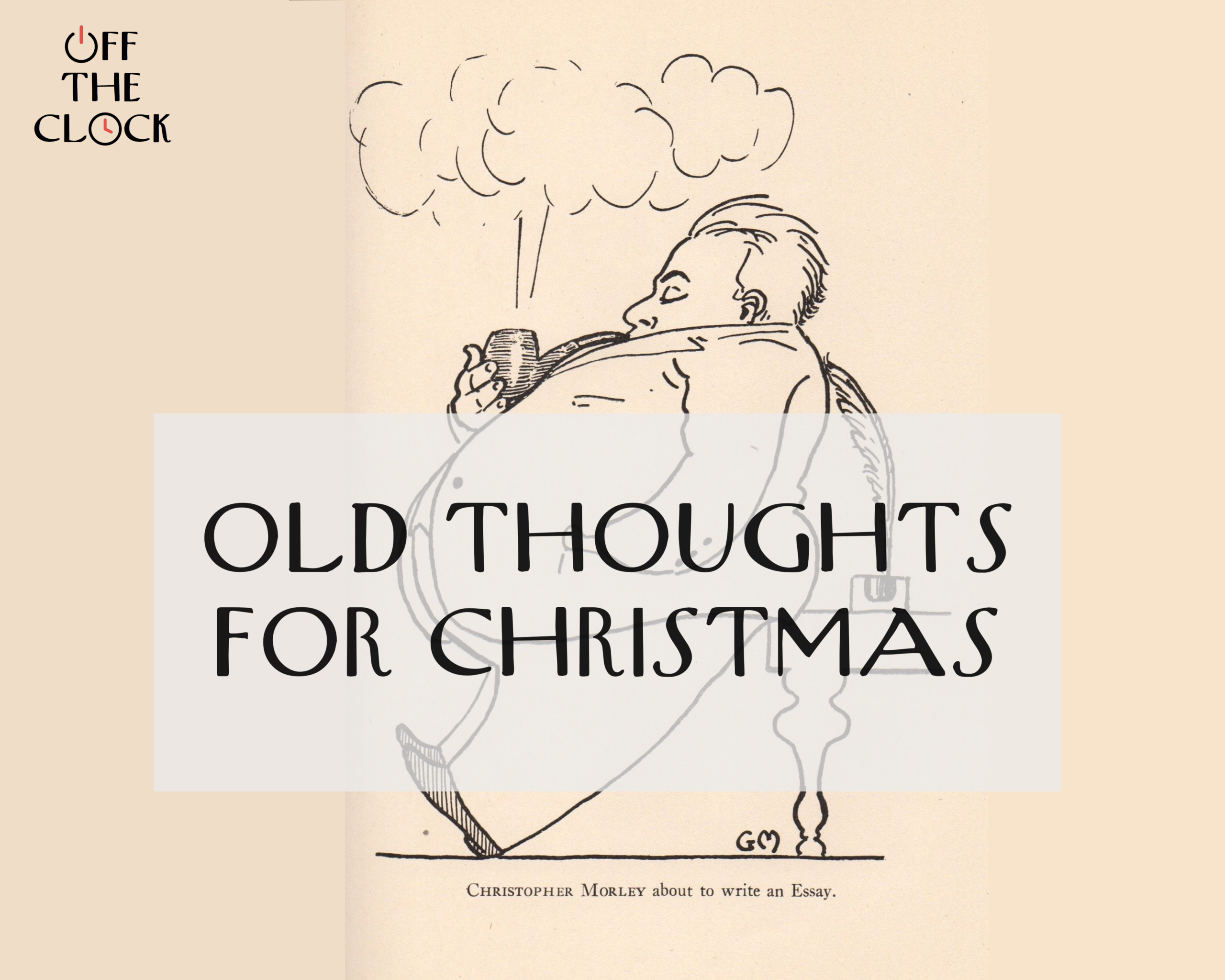
“Just for a few hours on Christmas Eve and Christmas Day the stupid, harsh mechanism of the world runs down and we permit ourselves to live according to untrammeled common sense, the unconquerable efficiency of good will.”
— Christopher Morley, 1919
Christopher Morley is no longer a household name, and that’s unfortunate.
There was a time in the early- to mid-20th century when Morley was known to readers of books, listeners of radio, and watchers of television as an erudite man of letters.
Morley wrote the bestseller Kitty Foyle in 1939, which was turned into the film that garnered Ginger Rogers an Oscar.1 He was a regular columnist in The Saturday Review of Literature.2 He was on the panel for the Book of the Month Club.3 He was a regular guest on Information Please with Clifton Fadiman.4
Frequently asked to write introductions, prefaces, and forewords for a variety of books, his most famous is his eternal “In Memoriam: Sherlock Holmes” for the Doubleday edition of the complete Sherlock Holmes stories following the death of Sir Arthur Conan Doyle in 1930.5
In short, his talent put him in high demand because his essays were and still are pure joy.
Mince Pie, published in 1919, was a collection of various essays, and excerpts from this one, “Old Thoughts for Christmas,” are perfect for sharing today.
Note: I have added emphasis in bold and italics on relevant phrases.

Old Thoughts for Christmas (excerpted)
A new thought for Christmas? Who ever wanted a new thought for Christmas? That man should be shot who would try to brain one. It is an impertinence even to write about Christmas. Christmas is a matter that humanity has taken so deeply to heart that we will not have our festival meddled with by bungling hands.
No efficiency expert would dare tell us that Christmas is inefficient; that the clockwork toys will soon be broken; that no one can eat a peppermint cane a yard long; that the curves on our chart of kindness should be ironed out so that the “peak load” of December would be evenly distributed through the year.
No sourface dare tell us that we drive postmen and shopgirls into Bolshevism by overtaxing them with our frenzied purchasing or that it is absurd to send to a friend in a steam-heated apartment in a prohibition republic a bright little picture card of a gentleman in Georgian costume drinking ale by a roaring fire of logs. None in his senses, I say, would emit such sophistries, for Christmas is a law unto itself and is not conducted by card-index. Even the postmen and shopgirls, severe though their labors, would not have matters altered. There is none of us who does not enjoy hardship and bustle that contribute to the happiness of others.
There is an efficiency of the heart that transcends and contradicts that of the head. Things of the spirit differ from things material in that the more you give the more you have… Especially if you have wit enough to give to those who don’t expect it. Surprise is the most primitive joy of humanity. Surprise is the first reason for a baby’s laughter. And at Christmas time, when we are all a little childish I hope, surprise is the flavor of our keenest joys. We all remember the thrill with which we once heard, behind some closed door, the rustle and crackle of paper parcels being tied up. We knew that we were going to be surprised—a delicious refinement and luxuriant seasoning of the emotion!
Christmas, then, conforms to this deeper efficiency of the heart. We are not methodical in kindness; we do not “fill orders” for consignments of affection. We let our kindness ramble and explore; old forgotten friendships pop up in our minds and we mail a card to Harry Hunt, of Minneapolis (from whom we have not heard for half a dozen years), “just to surprise him”…
A business man who shipped a carload of goods to a customer, just to surprise him, would soon perish of abuse. But no one ever refuses a shipment of kindness, because no one ever feels overstocked with it. It is coin of the realm, current everywhere. And we do not try to measure our kindnesses to the capacity of our friends. Friendship is not measurable in calories. How many times this year have you “turned” your stock of kindness?…
[W]e pass through the haggard perplexity of “Only Four Days More” when we suddenly realize it is too late to make our shopping the display of lucid affectionate reasoning we had contemplated, and clutch wildly at grotesque tokens—and then (sweetest of all) comes the quiet calmness of Christmas Eve. Then, while we decorate the tree or carry parcels of tissue paper and red ribbon to a carefully prepared list of aunts and godmothers, or reckon up a little pile of bright quarters on the dining-room table in preparation for to-morrow’s largesse—then it is that the brief, poignant and precious sweetness of the experience claims us at the full.
Then we can see that all our careful wisdom and shrewdness were folly and stupidity; and we can understand the meaning of that Great Surprise—that where we planned wealth we found ourselves poor; that where we thought to be impoverished we were enriched. The world is built upon a lovely plan if we take time to study the blue-prints of the heart.
Humanity must be forgiven much for having invented Christmas. What does it matter that a great poet and philosopher urges “the abandonment of the masculine pronoun in allusions to the First or Fundamental Energy”? Theology is not saddled upon pronouns; the best doctrine is but three words, God is Love. Love, or kindness, is fundamental energy enough to satisfy any brooder. And Christmas Day means the birth of a child; that is to say, the triumph of life and hope over suffering.
Just for a few hours on Christmas Eve and Christmas Day the stupid, harsh mechanism of the world runs down and we permit ourselves to live according to untrammeled common sense, the unconquerable efficiency of good will. We grant ourselves the complete and selfish pleasure of loving others better than ourselves.
How odd it seems, how unnaturally happy we are! We feel there must be some mistake, and rather yearn for the familiar frictions and distresses. Just for a few hours we “purge out of every heart the lurking grudge.” We know then that hatred is a form of illness; that suspicion and pride are only fear; that the rascally acts of others are perhaps, in the queer webwork of human relations, due to some callousness of our own. Who knows? Some man may have robbed a bank in Nashville or fired a gun in Louvain because we looked so intolerably smug in Philadelphia!
So at Christmas we tap that vast reservoir of wisdom and strength—call it efficiency or the fundamental energy if you will—Kindness. And our kindness, thank heaven, is not the placid kindness of angels; it is veined with human blood; it is full of absurdities, irritations, frustrations.
A man 100 percent kind would be intolerable. As a wise teacher said, the milk of human kindness easily curdles into cheese. We like our friends’ affections because we know the tincture of mortal acid is in them. We remember the satirist who remarked that to love one’s self is the beginning of a lifelong romance. We know this lifelong romance will resume its sway; we shall lose our tempers, be obstinate, peevish and crank. We shall fidget and fume while waiting our turn in the barber’s chair; we shall argue and muddle and mope.
And yet, for a few hours, what a happy vision that was! And we turn, on Christmas Eve, to pages which those who speak our tongue immortally associate with the season—the pages of Charles Dickens. Love of humanity endures as long as the thing it loves, and those pages are packed as full of it as a pound cake is full of fruit. A pound cake will keep moist three years; a sponge cake is dry in three days.
And now humanity has its most beautiful and most appropriate Christmas gift—Peace… If war is illness and peace is health, let us remember also that health is not merely a blessing to be received intact once and for all. It is not a substance but a condition, to be maintained only by sound régime, self-discipline and simplicity.
Let the Wise Men not be too wise; let them remember those other Wise Men who, after their long journey and their sage surmisings, found only a Child. On this evening it serves us nothing to pile up filing cases and rolltop desks toward the stars, for in our city square the Star itself has fallen, and shines upon the Tree.
Read the whole thing here.
And may the blessings of the holidays find their way to you, with peace in your heart and kindness on your lips.
There’s so much to learn,

Ginger Rogers could do much more than dance. Do yourself a favor and watch Kitty Foyle over the holidays.
The Saturday Review of Literature was a weekly “compendium of reportage, essays and criticism about current events, education, science, travel, the arts and other topics” that reached a peak of 660,000 subscribers.
Founded in 1926, Book of the Month exists to inspire and shape a more curious and thoughtful culture.
Information Please was an American radio quiz program that aired from 1938–1951 with Clifton Fadiman as host. Fadiman was co-founder of BOTMC and famously developed his Lifetime Reading Plan.
“In Memoriam: Sherlock Holmes” (Arthur Conan Doyle Encyclopedia)
💕💕💕💕