

Welcome to “Off the Clock,” a little something that lands somewhere between Timeless & Timely.
I send out this fun look at language and words every other Saturday as bonus content. If someone sent this to you, please consider subscribing.
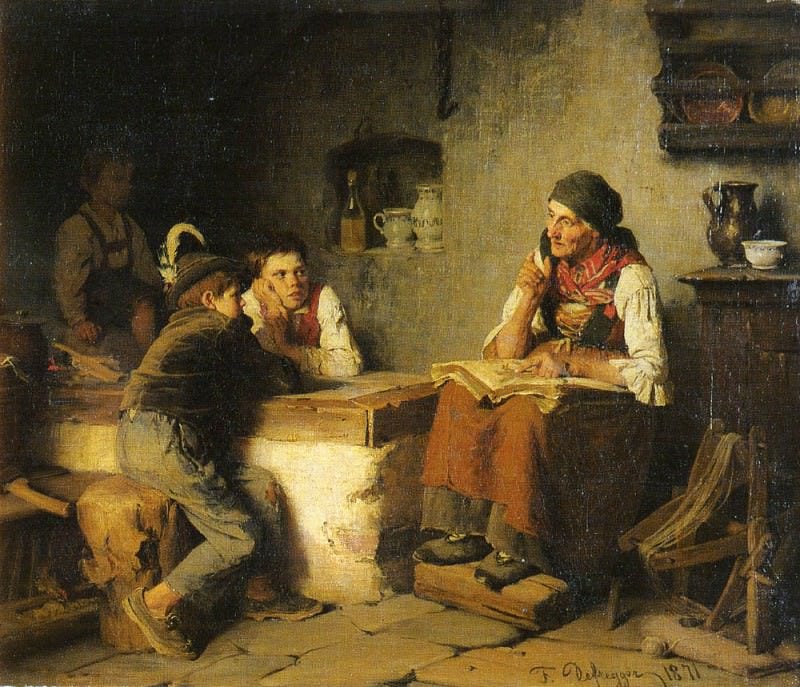
“People who are curious and passionate read; people who are apathetic and indifferent don’t.”
— Nolan Bushnell
Recent reports announce, almost like reporting quarterly company performance, that the time Americans devote to reading has suffered a collapse — down forty percent in the last two decades among U.S. adults 15 years and older.1
What once served as the quiet occupation of citizens in a republic of letters is now treated as the quaint pastime of antiquarians, as superfluous to modern life as the oil lamp or the fountain pen.
The rise of AI adds to the fuel of this conflagration of intellect, sparing us the trouble of sustained attention while entrusting the effort to some other entity that provides the erstwhile reader with summaries and interpretations, regurgitated as a mother bird does for her offspring.
The parallel to the mother bird regurgitating worms for her chicks is not accidental; it is the parable of our time. The difference, of course, is that the bird intends its sacrifice to nourish, whereas we seem content to be spoon-fed by devices whose interest lies not in our growth but in our sedation.2
As John Dickerson counsels, the defense against the algorithm is within our power if we begin each day with the simple act of reading:
Whether you choose to pick up a piece of fiction, a biography, a collection of essays or The Oxford Book of English Verse, the decision to eschew electrons for paper (or other electrons in an e-book reader) wards off brain rot.
More than keeping our most important organ from atrophying, reading gives us another power:

Ten Free Sites to Help with Your Reading Journey
1) Book Authority
It showcases the best books in over 4,000 categories including topics such as solopreneur, leadership, biography, folklore, language and writing, and much more. It is particularly useful for nonfiction readers.
2) The StoryGraph
This is a great Amazon-free alternative to Goodreads. It shares many more stats about the books you read and has a variety of features that you won’t find with Goodreads.
3) Hoopla
Hoopla is your public library at your fingertips. All you need is a library card and you'll get free access to audiobooks, ebooks, comics, movies, magazines, and even music.
4) Books Calculator
Use this book calculator to estimate how many books you can read in a month or year. It’s helpful for setting realistic reading goals and increasing your motivation to read more books.
5) Five Books
Discover the 5 best books on any topic. It covers fiction and non-fiction and provides many book recommendations for kids as well.
6) Librarian AI
Rather than using AI to summarize a book, instead use it to easily discover your next amazing book. Enter the name of your favorite book and it will give you 3–5 similar books to the one you loved.
7) Most Recommended Books
Want to know what books some successful people recommend? This site has book recommendations from 600+ successful people so you can easily find out what books they recommend reading.
8) Project Gutenberg
Project Gutenberg has more than 60,000 eBooks from the public domain available for free. You can download the files as ePub or Kindle eBooks.
9) LibriVox
LibriVox has a database of over 15,000+ free audiobooks. LibriVox audiobooks are free for anyone to listen to, on their computers, iPhones, or other mobile devices.
10) Library Extension
The Library Extension is not a website, but a browser extension. As you browse books and e-books on Amazon, the Library Extension checks your library's online catalog and displays the availability of matching items on the same page.
Do you have any sites or resources to add to this list? Curious minds want to know.
Meanwhile, I wish you the best on your morning reading.
There’s so much to learn,
“Why So Few Americans Read for Pleasure,” The Washington Post, August 20, 2025
“AI is making reading books feel obsolete – and students have a lot to lose,” The Conversation, August 13, 2025