

Words That Time Forgot (Mostly)
The archaic words we still speak every day, without knowing we’re speaking archaically

Welcome to Off the Clock — where we step away from the urgent and indulge the enduring.
Every other Saturday, I send a private note to subscribers exploring the curious corners of language, history, and the words we think we know—but don’t.
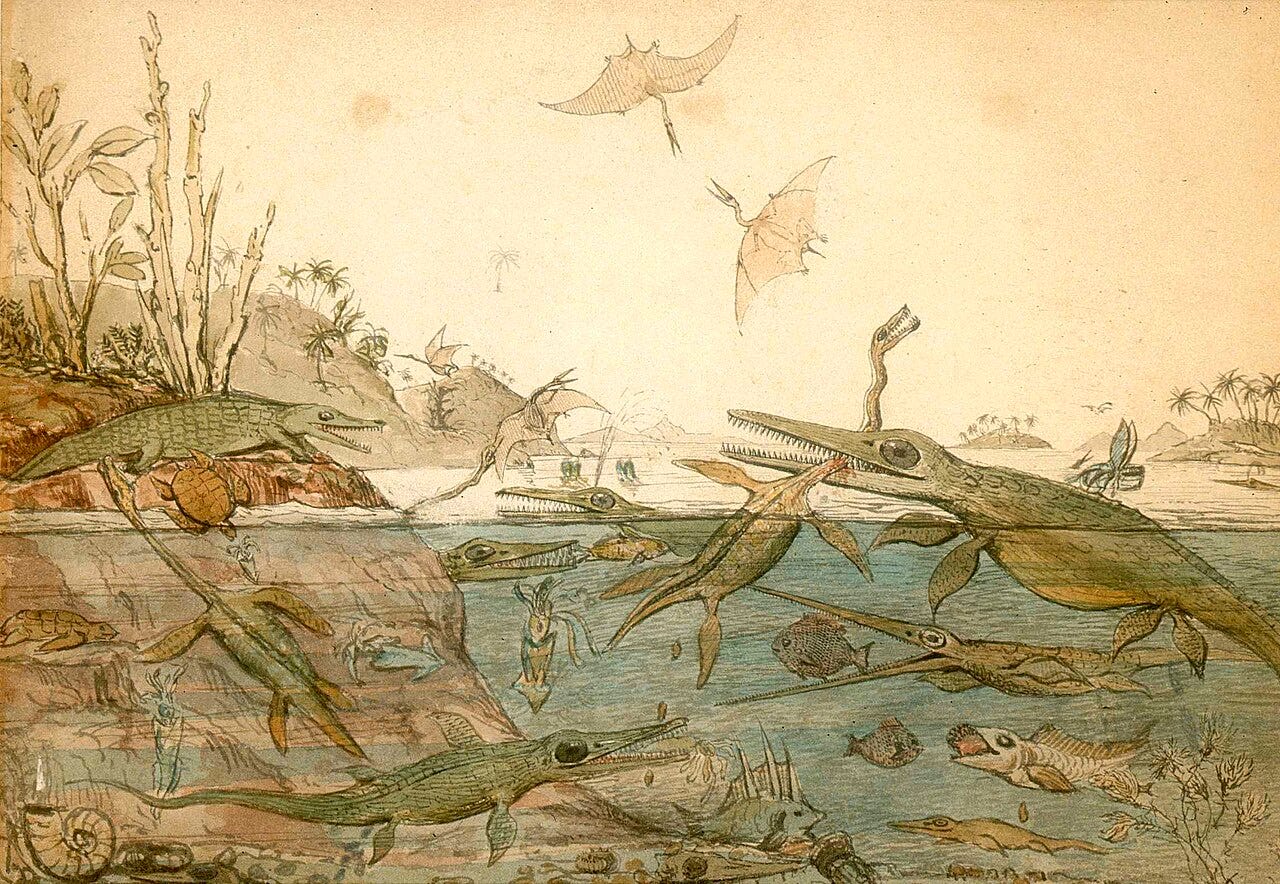
“Language is fossil poetry.”
— Ralph Waldo Emerson, 1844
I’ve never once, in my adult life, used the word “eke” by itself. Eke is always paired with “out” — eke out a living, eke out a win, eke out a paragraph on deadline.
And yet I understood it instantly the first time I heard it, the way you understand a word you’ve never looked up but have absorbed by osmosis, through sheer repetition of the phrase that carries it.
That’s because “eke” isn’t really a word anymore, in the sense that “run” or “table” or “disappointed” are words. It’s a fossil. It went extinct in the wild sometime in the last few centuries, and the only reason we still have it at all is that one particular phrase decided to preserve it, the way a mosquito gets caught in amber and outlives everything else in the forest.
Linguists have a real term for this: a fossil word, one that’s “broadly obsolete but remains in use due to its presence in an idiom or phrase.” The Oxford English Dictionary made this sense official in a 1993 update, though Emerson had already given us the poetry of it 150 years earlier: language itself as a kind of limestone, built from the compressed shells of a million dead metaphors.
Longtime readers may recall that we’ve brushed up against this territory before. A year ago, I wrote about phrases like “spick and span” and “vim and vigor,” where one half of the pair has quietly gone obsolete while the phrase itself refuses to die — I filed those under a subcategory I called simply “Fossils.”1
And a year before that, we looked at ping pong and flip flop, pairs locked in place by the order of their vowel sounds rather than by extinction.2
Fossil words are a related phenomenon, but a broader one. They don’t have to travel in pairs, and they’re not bound by any rule of sound. They’re simply words that lost their independence — words that no longer work alone, and survive only because they once got lucky enough to be standing next to the right neighbor when the rest of their generation got wiped out.
So consider this a companion piece to that earlier dig. Let’s excavate ten of them. And for those with some vim, an impressive etymological feat awaits you at the conclusion of the list: all ten of these fossil words are combined in two sensible sentences.
Ready? Let’s dive in. With each word, you get the definition, its origin, and an example of it in a sentence.
Ten Fossil Words
Ado
Bother or fuss over something trivial.
From an old Northern English construction, “at do” — literally “to do” — that fused into a single word. Shakespeare gave it permanent shelter by putting it in a title in 1598: Much Ado About Nothing.
The board spent the first hour arguing about parking before, without further ado, turning to the actual merger.
Bated
Restrained, held in check
From “abate.” Its only surviving job is standing next to “breath.” Shakespeare is the earliest source we have for the phrase, in The Merchant of Venice (1596–98): Shylock speaks of addressing a rival “with bated breath and whisp’ring humbleness.”
The interns waited with bated breath while the partners filed back in to deliver a verdict on the pitch.
Fro
Away, or backward.
A dialectal cousin of “from,” borrowed from Old Norse “frá” and current in Northern English and Scots by around 1200. In modern English it does exactly one job: standing across from “to.”
The porch swing kept creaking to and fro long after everyone had gone inside for the night.
Eke
To supplement or make something stretch further
From Old English “eacian,” “to increase” — a distant cousin of “augment.” Ironically, the phrase has drifted from its own original sense: “eke out a living” once meant supplementing a fixed income, not scraping by on nothing.
During the lean years after the factory closed, the family eked out a living selling vegetables from a roadside stand.
Kith
Acquaintances, neighbors, one’s own country
Old English “cyþth,” related to words for “knowledge.” A thousand years ago it could mean your homeland or simply what you knew; today it survives only as the first half of “kith and kin,” a pairing first recorded in the late 1300s.
When the storm hit, half the town’s kith and kin crowded into the high school gymnasium until the water finally receded.
This post is for paid subscribers. What follows is the back half of the dig — five more fossils, including one that Shakespeare coined as an insult and one that Mark Twain popularized as a shrug — plus an attempt (foolish, possibly doomed) to use all ten words in a single closing paragraph. If that sounds like a fair trade for the price of a coffee, the door’s just below.

