


“How gloriously legible are the constellations of the heavens!”
— Anthony Trollope, 1859
Life is filled with uncertainty. At any given moment, thousands of tragedies unfold across the globe—micro-moments affecting millions of families, each cocooned within its own fragile world.
The devastating death of a child. The sudden, disorienting prospect of losing a job. The quiet, grinding anxiety of forces beyond our control.
And then there are the macro-moments we share—events so large that humanity, for a brief instant, looks in the same direction. Moments that find us both at our worst (in the case of war and a threat to wipe out an entire civilization) and our best.
Earlier this week, a global event played out on our screens that, even for a moment, reaffirmed a belief in the goodness of humanity: the interactions with the crew of Artemis 2, as it made its way to the Moon and back.
And a little humanity is exactly what we needed now.
Another Hunter
NASA’s first lunar program was named Apollo — the sun god, driving his chariot across the sky. It was an apt name for humanity’s first reach into the heavens.
More than a half century later, Artemis returns us there. Named for Apollo’s twin sister, goddess of the moon: a hunter, like her brother — but also a guardian. Protector of women and children. A quiet symmetry, then, that this mission carries Christina Koch as the first woman on a lunar flight.
Humanity in the Stars

“The fault, dear Brutus, is not in our stars,
But in ourselves”
— William Shakespeare, 1599
Since Apollo 17 in 1972, technology has advanced so rapidly that a return to the Moon could feel almost routine—another unveiling, another headline, another fleeting moment.
And yet…
For a brief time, humanity looked up again.
As attention united humanity on this mission and this crew, we turned our faces toward the skies, just as the ancient Greeks once did, giving a sense of awe and wonder to forces beyond our understanding.
Long before telescopes gave us distance, the ancient Greeks gave the heavens meaning. As they looked aloft, they did not see cold points of light, but stories — heroes frozen mid-trial, lovers bound together in permanence, monsters defeated yet immortalized.
They gave us figures like Orion, Andromeda, and Cassiopeia, mapping the human condition onto the night sky. The stars became less a mystery than a mirror of humanity — reflecting ambition, hubris, sacrifice, and fate — reminding them, and now us, that even in the vastness of the cosmos, we have always searched first for ourselves.
Messages of Love
In a week that included Easter Sunday and Passover — two symbols of love and sacrifice — even amid conflict in those ancient lands, the crew of Artemis 2 offered something quieter, but no less powerful.
First, the crew shared names for two craters they observed on the Moon: one was named “Carroll,” a neonatal nurse and late wife of Commander Reid Wiseman, who died in 2020. The emotion with which the news was given to Mission Control and then the supportive group hug were enough to bring tears to millions of eyes around the world:
More poignantly, just before losing contact on the far side of the Moon, Pilot Victor Glover offered a reflection that reached far beyond the mission.
He reminded us that what unites us is far stronger than what divides us:
“In all of this emptiness — this is a whole bunch of nothing, this thing we call the universe — you have this oasis, this beautiful place that we get to exist together. I think, as we go into Easter Sunday, thinking about all the cultures all around the world, whether you celebrate it or not, whether you believe in God or not, this is an opportunity for us to remember where we are, who we are, and that we are the same thing, and that we’ve gotta get through this together.”
That’s what we are: together. And it is the only way we have ever done anything that matters.
As the module approached the other side of the Moon, Glover continued:
“Thank you to all of you for allowing us the immense privilege to be on this journey together…
As we get close to the nearest point to the moon and farthest point from Earth, and as we continue to unlock the mysteries of the cosmos, I’d like to remind you of one of the most important mysteries here on Earth: love. Christ said, in response to what was the greatest commandment, that it was to love God with all that you are. He also said the second is equal to it: love your neighbor as yourself.
So, as we prepare to go out of radio communication, we’re still going to feel your love from Earth. And to all of you down there on Earth, and around Earth, we love you from the moon.”
The ancient Greeks looked to the stars and found stories of who they were—flawed, striving, hopeful. We have traveled farther than the Greeks could have imagined, and yet we are still asking the same questions.
Who are we? What binds us? What matters?
From the far side of the Moon, the answer came back not as data, but as something far older.
Not power, fame, progress, or money.
Love.
And the quiet reminder that, in all this vastness, we are still in this together.
There’s so much to learn,

About the top image
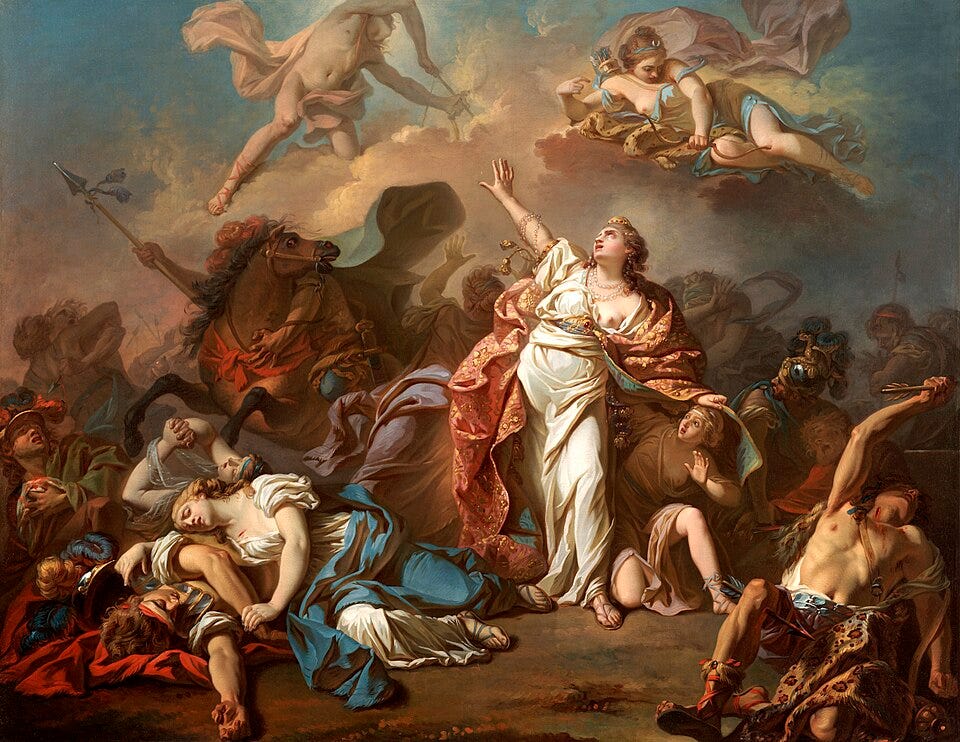
Niobe, queen of Thebes and daughter of King Tantalus, boasted of her many children, claiming superiority over Leto, the mother of the twin deities Apollo and Artemis. Offended by her arrogance, Leto sent her children to punish Niobe. In Thebes, Apollo killed all of Niobe’s sons, while Artemis killed all of her daughters.
In 1772, the French neoclassical painter Jacques-Louis David captured the emotional turmoil of Niobe as she witnesses the divine retribution, with her children being killed by Apollo and Artemis. It is a powerful visual reminder of the vice of hubris.
I enjoyed your theme today. I have a hand written post it at the bottom of my computer screen: Love is always the Lesson. It goes with my universal theme that Love is always the Answer.