

The Prosperous Fool
Or, One in a Trillion: having ungodly amounts of money isn’t morally wrong. But the way we deify it is.
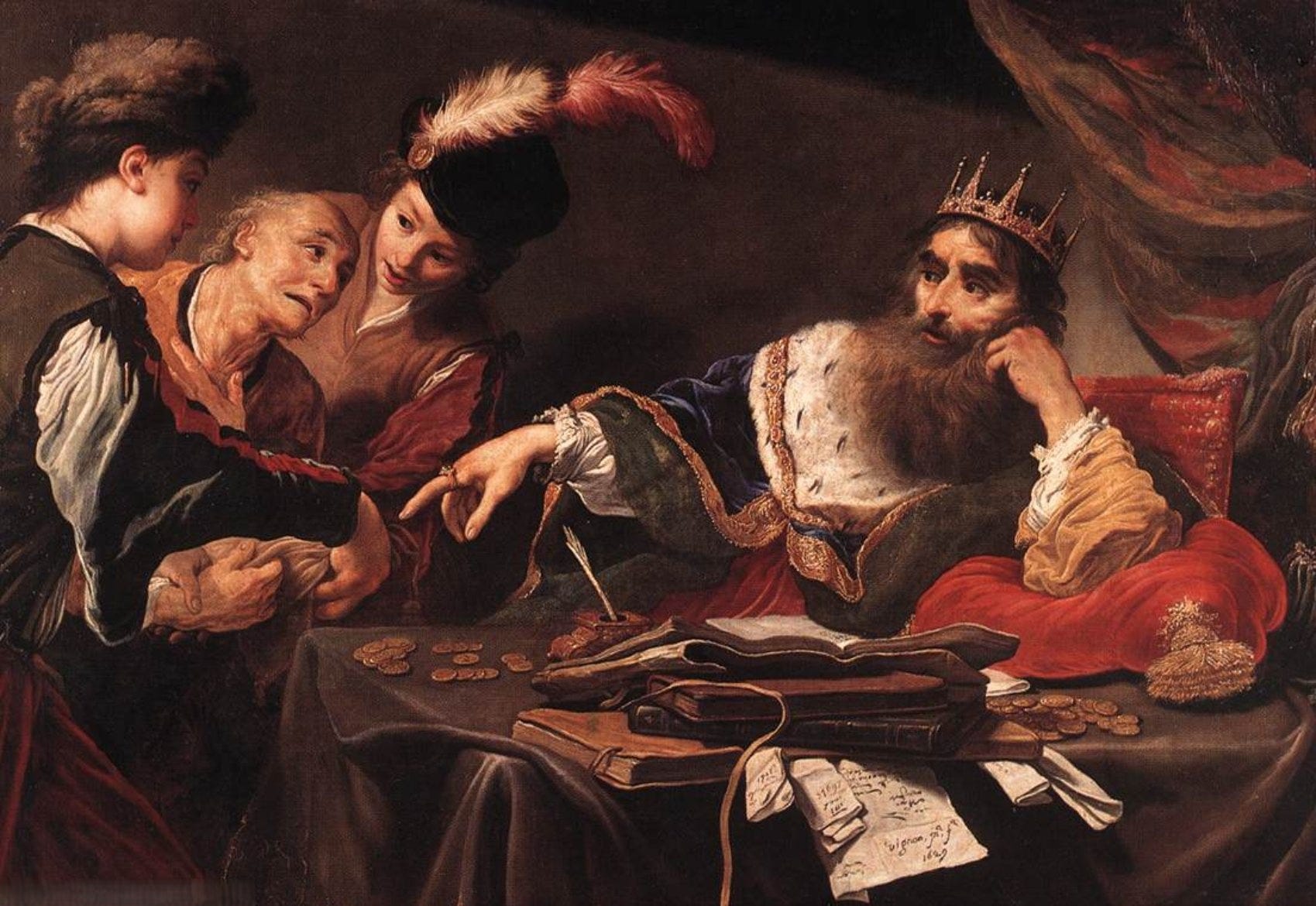
“I wanted the gold, and I got it—
Came out with a fortune last fall,—
Yet somehow life’s not what I thought it,
And somehow the gold isn’t all.”
— Robert W. Service, 19071
Around 560 BC, the richest man in the known world received a visitor. Croesus, king of Lydia, had accumulated such staggering wealth that his name became, and has remained for twenty-five centuries, a synonym for fortune beyond measure.
He welcomed Solon, the Athenian lawgiver and sage, into his treasury, festooned with gold and jewels and the haul from conquered kingdoms — and then asked the question he already knew the answer to: who was the happiest man alive?
Solon named Tellus of Athens, a simple man who had lived well, raised honorable children, and died defending his city. Croesus, unsatisfied, pressed him. Surely, among all the men Solon had encountered in his travels, Croesus ranked near the top?
The philosopher shook his head. “Call no man happy until he is dead.”
Not because happiness is impossible, but because the full accounting — what a life cost, what it was worth, what it left behind — cannot be rendered until it is complete.
Croesus dismissed Solon as a fool.
He would later lose his kingdom to Cyrus the Great, and when facing execution on the funeral pyre, cried out three times the name of the man he had sent away unanswered: “Solon. Solon. Solon.”
Out of This World
On June 12, 2026, when SpaceX priced its initial public offering at $135 a share and the stock soared on its first day of trading, Elon Musk — already the most distant outlier in the history of recorded wealth — crossed $1 trillion in personal net worth. The first trillionaire in human history.
The number resists ordinary comprehension: a trillion dollars exceeds the GDP of most nations on earth, exceeds the combined wealth of the next five richest people in the world, exceeds any individual accumulation our species has ever produced.
The question Solon asked of Croesus is the question history now asks of us.
The tension between wealth and morality is not a modern invention. Aristotle diagnosed the disease in the fourth century BC, calling it pleonexia — the sickness of always wanting more. He observed that it split every society into a city of the rich and a city of the poor, at permanent war with each other. He warned of the “prosperous fool”: the class of men so intoxicated by the love of money that “they therefore imagine there is nothing it cannot buy.”
Money and Class
“Wealth is not inherently evil — it is simply a tool. But when wielded by those who value it above all else, it becomes a force that undermines the moral fabric of society.”
— Lewis H. Lapham, 2018
Lewis Lapham, the great chronicler of American plutocracy, spent a career watching the prosperous fool come into his inheritance. In Money and Class in America, he examined not merely the acquisition of wealth but the moral architecture that wealth erects around itself — the way it conflates net worth with virtue, fortune with wisdom, and market capitalization with human worth.2
Voltaire understood this with characteristic sharpness: “When it’s a question of money, everybody is of the same religion.” In Lapham’s estimation, it is a civil religion — one that has colonized the moral and cultural space once reserved for faith, duty, and civic responsibility.
What all of them understood — Aristotle, Voltaire, Lapham — is that money is not inherently corrupting. It is a tool. The corruption lies in the confusion of the tool for the purpose, the instrument for the end.
Comic Sans
There is an instructive counter-example hiding in plain sight. In 1991, a cartoonist named Bill Watterson, creator of Calvin and Hobbes — one of the most beloved comic strips in the history of the medium — sat down to negotiate with United Press Syndicate over a sum of money that would have made him a very wealthy man indeed.
“The syndicate” (as he called them, appropriately designating them as some group of criminal masterminds) wanted to license Calvin and Hobbes: toys, t-shirts, an animated series, the full commercial machinery. Watterson said no. He said no for six years, while trainloads of money waited at the station. “I went into cartooning to draw cartoons,” he explained, “not to run a corporate empire.”
In the end, Watterson won. But the more interesting fact is that he never considered it a question of business at all. For him, it was a question of integrity. He understood that the moment Calvin became a product, something essential would be lost — not something he could name on a ledger, but something that could only be understood by the millions of readers for whom the strip constituted “private realities, the magic of imagination, and the specialness of certain friendships.” He chose that over the money.3
The world’s first trillionaire chose otherwise.
Goldfinger
The Midas myth is almost exactly the story of where we find ourselves today. Midas, king of Phrygia, was granted a wish by the god Dionysus: that everything he touched would turn to gold. The wish was granted. And for one bright morning in antiquity, Midas rejoiced as sticks and stones and sunflowers became precious metal.
Then so did his food, and his drink, and the things and people he loved. He would have died of thirst and hunger had the god not released him from the prison of his own desire.
The ancient king was self-aware enough to realize that something was amiss. He recognized the prison and requested parole. Whether the world’s first trillionaire — who simultaneously controls electric vehicles, private space flight, satellite internet, social media, and a seat at the table of government — has noticed any gold on his food is a question the ledger cannot answer.
Schopenhauer was right: the accumulation of wealth, pursued without limit, is like a gilded cage that “prevents people from pursuing the true, intangible rewards of life — love, wisdom, and spiritual fulfillment.”
Now imagine a gilded cage the size of a civilization.
My Kingdom for a Sled
Kareem Abdul-Jabbar, reflecting on the milestone this week, reached for the most searching account of this transaction ever put on screen: Citizen Kane.
“We have built a culture that celebrates the world-gainers with very little curiosity about what they traded to get there. Net worth has become our proxy for wisdom, which is how we end up inviting the wealthiest person in the room to lecture us on education, public health, and democratic values — subjects where accumulated fortune confers exactly zero wisdom or expertise.”4
Or, put as another wise soul wrote last year:
“Society, in its haste to worship the rich, has conflated wealth and morality.”
Charles Foster Kane — Orson Welles’s monument to the American promise corrupted — died speaking a word that meant nothing to anyone around him: “Rosebud.” The name of a childhood sled. Everything he had traded away first, before he knew what the road would cost.
One wonders what Elon Musk’s “Rosebud” will be.
At What Cost?
Solon told Croesus that happiness cannot be judged in the midst of life, only at its end — and not by the man himself, but by history. Croesus wasn’t wrong to be rich. He was right about everything except what the wealth meant. He had the gold, the armies, the territory, the admiration. He had missed Solon’s point entirely — which was not that prosperity is a curse, but that prosperity is not the measure.
We have built a civilization in which the accumulation of money has become the primary measure of human worth. And now we have arrived, for the first time in our species’ history, at the summit of that civilization: a single human being worth a trillion dollars.
The question Solon would ask is not how did he get there, but what did the journey cost — and not only to him.
The first trillionaire has everything — except, perhaps, the one thing that makes wealth meaningful: a life well-spent in service to something larger than himself.
In the end, it is not the wealth we accumulate that defines us. It is the moral choices we make with it, or in spite of it, that history will remember.
There’s so much to learn,


Of America and the Rise of the Stupefied Plutocrat
The 2018 foreword to the reissue of Money and Class in America is one of the essential documents for understanding how we arrived here. Lewis Lapham traces the arc from Reagan’s “release of the free market from the prison of government regulation” to what he calls the conversion of “a weakened but still operational democracy” into “a dysfunctional, stupefied plutocracy.” (Literary Hub)
Calvin and Hobbes and the Price of Integrity
Matthew Morgan’s deeply researched account of Bill Watterson’s six-year battle with his syndicate over the licensing of Calvin and Hobbes is a study in what it costs to hold a principle when the alternative is a very large check. Watterson refused millions in merchandise deals, not because he was naive about money, but because he understood that art and commerce operate on different currencies — and that confusing the two destroys the thing you were trying to protect. A useful corrective to the era of wealth-without-work. (The Republic of Letters)
Malefactors of Great Wealth
Theodore Roosevelt’s 1907 speech gave this essay its title and its organizing tension: “In the man of great wealth who has earned his wealth honestly and uses it wisely we recognize a good citizen.” The question, which TR left open and our era has answered badly, is what happens when the recognition is granted regardless of the “wisely.” (Timeless & Timely)

The Billionaire Puzzles
Can one person be too rich for democracy to work? Who decides what the winners owe? Can the winners fix the game they won? Raj Chetty’s research on mobility — from 90% of children out-earning their parents (born 1940) to roughly 50% (born 1980s) — is the sharpest empirical frame for why the trillionaire milestone is not merely a financial curiosity. (John Dickerson)
The Knicks, Trump’s Octagon, and the World’s First Trillionaire
Kareem Abdul-Jabbar invokes Citizen Kane and asks the question that no ledger can answer: what is Musk’s “Rosebud”? His observation that “net worth has become our proxy for wisdom” is the cultural diagnosis that pairs with Dickerson’s structural one. For those who prefer their moral philosophy delivered with a jump shot. (Kareem Takes on the News)
The Founder of Craigslist Has Given Away Half a Billion Dollars
In a world where a growing number of billionaires are lashing out against philanthropy, Craig Newmark has a message for them — and everyone else (The Independent)
“The Spell of the Yukon,” Poetry Foundation
Lewis H. Lapham, Money and Class in America: Notes and Observations About Our Civil Religion, 1988
“Calvin and Hobbes and the Price of Integrity,” by Matthew Morgan, The Republic of Letters, June 11, 2026
“The Knicks, Trump’s Octagon, and the World’s First Trillionaire,” by Kareem Abdul-Jabbar, Kareem Takes on the News, June 16, 2026