

The Postliterate Heart
Why the disappearance of deep reading is quietly costing us the empathy that holds teams — and civilizations — together.
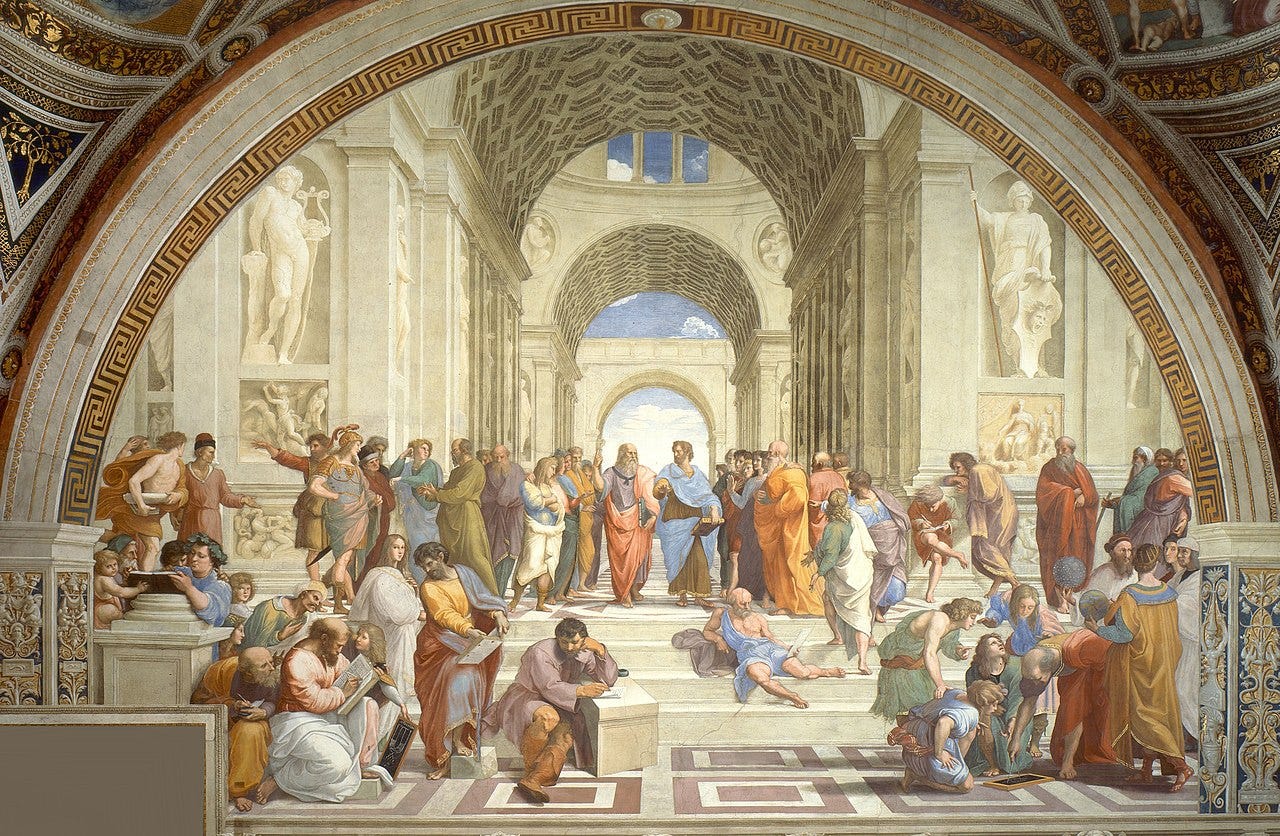

“You think your pain and your heartbreak are unprecedented in the history of the world, but then you read. It was Dostoevsky and Dickens who taught me that the things that tormented me most were the very things that connected me with all the people who were alive, or who ever had been alive.”
— James Baldwin, 1963
Every few years, we seem to find ourselves standing in the midst of a socio-intellectual panic over waning interest in the practice of reading. This is hardly a new phenomenon.
About 2,000 years ago, Seneca diagnosed a crisis of attention, caused by an oversupply of papyrus. Scrolls had gotten cheap, wealthy Romans amassed libraries they’d never finish, and Seneca watched their minds grow “restless and unsteady,” noting “One who is everywhere is nowhere.”
“The first sign of a settled mind is that it can stay in one place and spend time with itself.”
— Seneca, 62
That line is the perfect summary of the latest argument in The Atlantic’s sprawling new essay on America’s “postliterate age,”1 where the algorithm in your pocket takes the blame. It isn’t wrong, but the pain is older than TikTok. It’s the ache of having too much to attend to and no discipline, individual or civilizational, for choosing well.
What’s different now is the scale: fewer than half of American adults read a book of any kind last year, and the proportion reading for pleasure on a given day has fallen from 28 percent in 2004 to 16 percent today. Reading, once a civic habit, has become what Rutgers reading historian Leah Price calls “a kind of niche hobby, like stamp collecting or growing orchids.”2
Now imagine that hobbyist population is also the population responsible for training the algorithms that decide what the rest of us see.
Warning: Idiocracy Ahead
“We cannot choose to become idiots.”
That line belongs to Roberto Serrano, a Brown University economics professor who gave his students a take-home midterm this spring and watched the class average land at 96 percent — sixteen points above his historical norm. Suspicious, he ran the exam through ChatGPT and got back answers that mirrored his students’: technically correct, oddly convoluted, unmistakably synthetic.
So, he switched the final to an in-person exam. Eighteen students dropped the course. The average score on the final: 48.6 percent, a historic low.3 Take a look at the distribution:
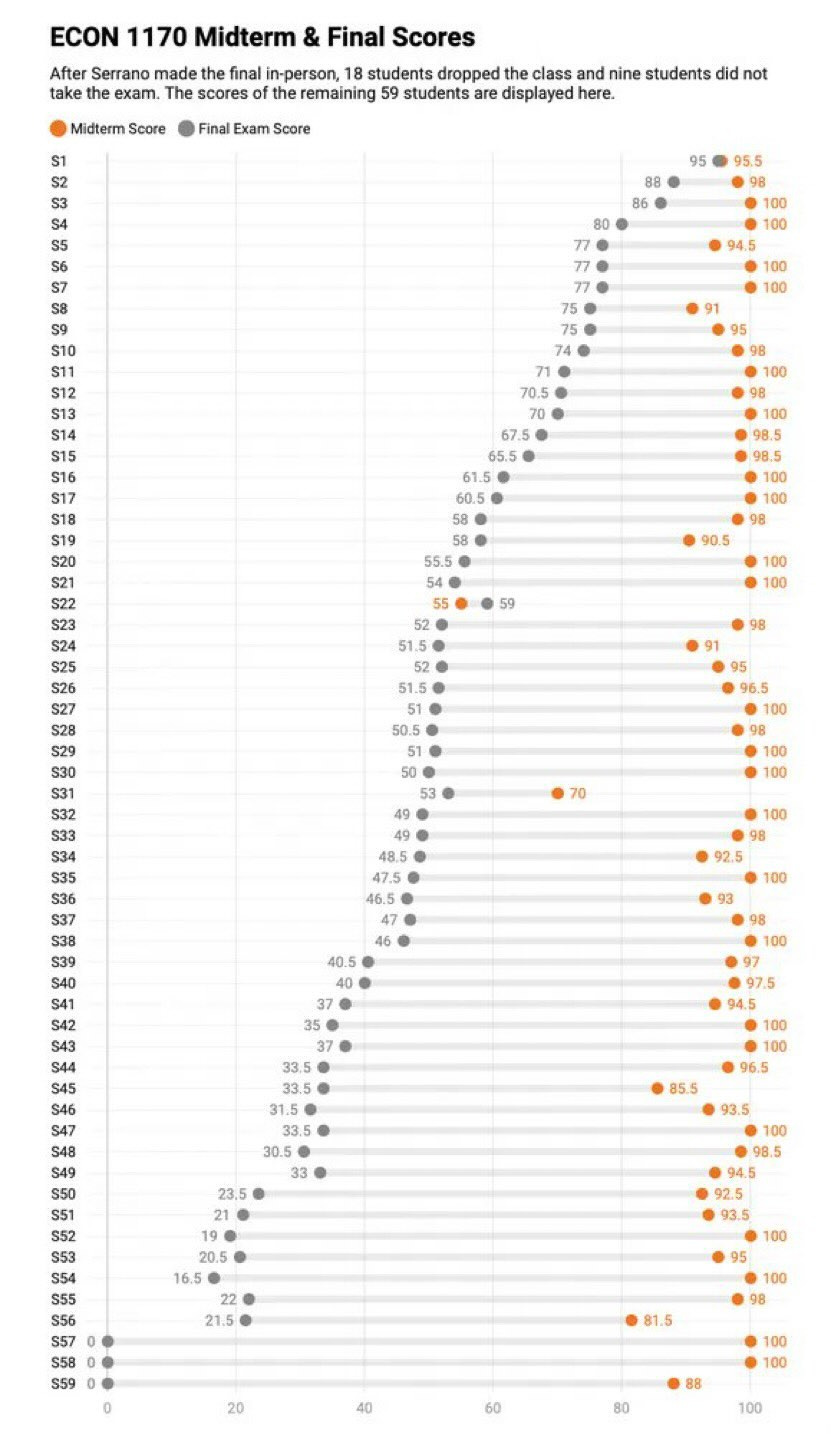
“We cannot afford to have a society in which a significant fraction of our best young minds think that cheating is OK. That leads to a declining society, to a failed society… We cannot choose to become idiots.”
— Roberto Serrano, Brown University, July 2026
Employers seem to agree: there is a concern that the decline in literacy rates, social skills, and critical thinking abilities is affecting the workplace. It’s gotten so obvious that one financier said that his firm now avoids “AI-native” STEM graduates in favor of humanities majors, because the AI-fluent hires keep turning out to have alarmingly shallow ideas. “We want critical thinking, not just AI,” he said.4
The Land of Nectar and Honey
Here is where Seneca becomes more useful than either headline. He compared deep reflection to what bees do with nectar: they pass it among themselves, mixing it with enzymes until it becomes honey. Nectar sours in days. Honey, properly made, doesn’t spoil for millennia.
Information is nectar. Wisdom is honey. And the difference between them isn’t the raw material — it’s the digestion.
What if we sat with just one idea a day, planted by reading? Simplicity and focus rather than complexity and an overcrowded library. It becomes easier to parse through concepts, to remember what we read, and to apply it more deeply to what we need.
Sherlock Holmes knew this in his very first appearance before the public:5
“I consider that a man’s brain originally is like a little empty attic, and you have to stock it with such furniture as you choose. A fool takes in all the lumber of every sort that he comes across, so that the knowledge which might be useful to him gets crowded out, or at best is jumbled up with a lot of other things so that he has a difficulty in laying his hands upon it. Now the skilful workman is very careful indeed as to what he takes into his brain-attic. He will have nothing but the tools which may help him in doing his work, but of these he has a large assortment, and all in the most perfect order. It is a mistake to think that that little room has elastic walls and can distend to any extent. Depend upon it there comes a time when for every addition of knowledge you forget something that you knew before. It is of the highest importance, therefore, not to have useless facts elbowing out the useful ones.”
The Chapter Everyone Skips
“A trust problem disguised as a literacy problem.”
And here is the part of the reading-crisis conversation that keeps getting skipped: reading was never primarily a data-delivery mechanism. It’s an empathy-delivery mechanism — the honey made from other people’s nectar.
I made a version of this case in these pages last year: we read many books because we cannot know enough people. Harold Bloom put it better, describing reading’s gift as “a real capacity for apprehending otherness,” a way past the trap of our own mortality into some real sense of other selves.6
That capacity isn’t a soft skill; it’s the operating system of a functioning team. Our Working TogetherTM system opens with a posture, not an org chart: seek to understand before seeking to be understood; people first, love ‘em up.7 You cannot execute either instruction toward a person you’ve never bothered to imagine from the inside.
Literature is the cheapest empathy-training available to the species, and its dividends compound — a leader who’s spent a few thousand hours inside the consciousness of others walks into a hard conversation already fluent in a language most colleagues are still learning on the job.
Trust isn’t built by transaction. It’s built through the practice of everything that precedes it, and books are where we put in our reps.
Take away the emotional connection and teams stop trusting each other because no one has practiced imagining anyone else’s interior life in years. Cal State Chico ethics professor Troy Jollimore’s warning — “massive numbers of students are going to emerge from university with degrees, and into the workforce, who are essentially illiterate”8 — isn’t only a literacy problem. It’s a trust problem disguised as a literacy problem.
We are, in other words, several decades into a neglect not unlike the one that quietly emptied the Great Library of Alexandria — not a single dramatic fire, but centuries of scrolls left to rot while no one thought preservation worth the expense. The classicist Roger Bagnall’s line from The Atlantic article has stuck with me since I first read it:
“It is not that the disappearance of a library led to a dark age, nor that its survival would have improved those ages. Rather, the dark ages... show their darkness by the fact that the authorities both east and west lacked the will and means to maintain a great library.”
Have we lost the will to read?
None of this requires despair — only, per Seneca, the harder discipline of attention. You don’t need to finish every book in the library. Most mornings, you just need one idea, held long enough to become honey instead of nectar.
Do that consistently, with your team and in your family, and you’re quietly rebuilding the exact muscle the postliterate age is letting atrophy: the capacity to imagine your way into someone you’ll never fully know.
There’s so much to learn,
From the Timeless & Timely archives
“To Read Is to Live” (2022) — on the Library of Alexandria and the permanence of the written word.
“The Real Reason to Read” (2025) — the empathy argument, with Harold Bloom and Alan Mulally.
“The Best Leadership Advice of All Time” (2022) — Thales, distraction, and the discipline of knowing yourself.
Rose Horowitch, “The Age of Reading Is Over,” The Atlantic, August 2026 issue.
Ibid.
Emma Whitford, “Brown Professor Suspects Majority of His Class Used AI to Cheat,” Inside Higher Ed, July 8, 2026.
Gillian Tett, “Humans still matter more than AI in finance,” Financial Times, May 8, 2026.
Arthur Conan Doyle, A Study in Scarlet, 1887
“The Real Reason to Read,” Timeless & Timely, March 16, 2025 (Harold Bloom quotation on “apprehending otherness”).
More about my speaking and advising on the Working TogetherTM Leadership & Management System entrusted to me by former Ford CEO Alan Mulally: https://scottmonty.com
Joe Wilkins, “Bosses Horrified as ‘AI Native’ College Graduates Hit the Workplace,” Futurism, May 9, 2026