


Welcome to Off the Clock — where we step away from the urgent and indulge the enduring.
Every other Saturday, I send a private note to subscribers exploring the curious corners of language, history, and the words we think we know—but don’t.
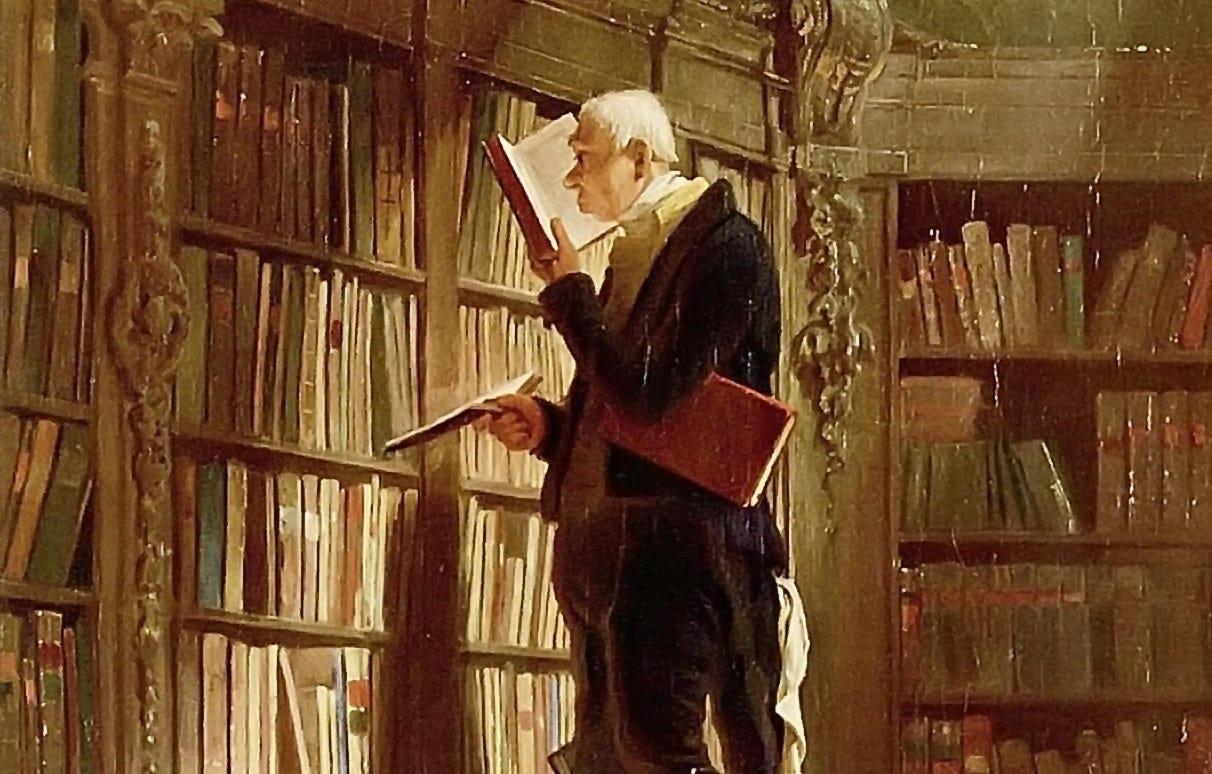
[Special thanks to Helena Bouchez, who writes The Book Works, for the find.]
In his letters, Gustave Flaubert wrote:
“Do not read as children do to enjoy themselves, or, as the ambitious do to educate themselves. No, read to live.”
Read to live.
Books are voyages of discovery. And with them, you can get your passport stamped on destinations around the world and throughout all of time.
See the fog-enshrouded streets of Victorian London, walk the newly-laid cobblestones of the Via Appia in the second century BC, experience Hemingway’s Spanish bullrings of the 1920s, and smell the air in James Fennimore Cooper’s Mohican country of the 1750s.
“I have a passport to a far better age, As close as the bookshelf, as near as a page.”
— William Schweikert, 19841
Destination Unknown
But here is what no one puts on the passport application: the best destinations are the ones you never planned to visit.
There is a particular species of joy that belongs exclusively to the browser — the person who wanders into a used bookstore without a list, who runs a finger along the spines of water-damaged paperbacks in a church basement sale, who follows a footnote into a wing of the library where the lights flicker on only when you walk in.
This is the joy of the unexpected find: the serendipitous shelf.
The algorithms, of course, have no interest in such visceral joy. They can’t smell the sweet elixir made from decaying pages, giving off the scent of vanilla, almonds, and musty paper.2 Or feel the thrill of finding a volume that has been like a white whale to you.
No, the algorithms are curators of the confirmed, showing you what you already like, amplified. They mistake your history for your appetite. And so, over time, the recommendation engine narrows the aperture of what you might ever encounter. You are given a library, but it is a library with walls closing slowly inward.
The Alternative
The solutions are many: the used bookstore, the public library’s discard bin, the estate sale with three tables of paperbacks at a quarter each, where a cracked spine catches your eye and you open to a random page and find a sentence that speaks directly to something you have been trying to think through for weeks.
I have found my best books this way. Not the ones I was looking for. The ones that found me.
There is something almost mystical in the encounter. The book has been waiting — sometimes for decades — and you have arrived, at last, to collect it.
A two-volume set on the essays and letters of E.B. White. A children’s natural history from 1887 with illustrations so alive they seem ready to leap from the foxed pages. A copy of a book already in my collection, but this one with an inscription to a titan of our shared hobby, making it a valuable association copy that comes with a story.
None of these would have appeared in a “You might also enjoy...” carousel. All of them changed how I think.
And now, for those of us who cannot always make it to the physical stacks, I have found something wonderful I’d like to share with you — a digital equivalent of reaching blindly into the dark and pulling out something extraordinary.
🔒 The rest of post is for paid subscribers.
What follows is a tour of one of the most delightful tools I’ve encountered for the purposeful wanderer with a curious mind. There’s a reason the most interesting minds you’ve ever met have usually read the most improbable things.
[Subscribe to keep reading →]
Paid subscribers also receive access to the full archive, the fortnightly Off the Clock letter on language and history, and all future essays. The cost is less than a used paperback a month — and considerably more surprising.

