

The Examined Life Is Not Optional
Introspection is not a recent phenomenon. Those who tell you to ignore it want your attention elsewhere.
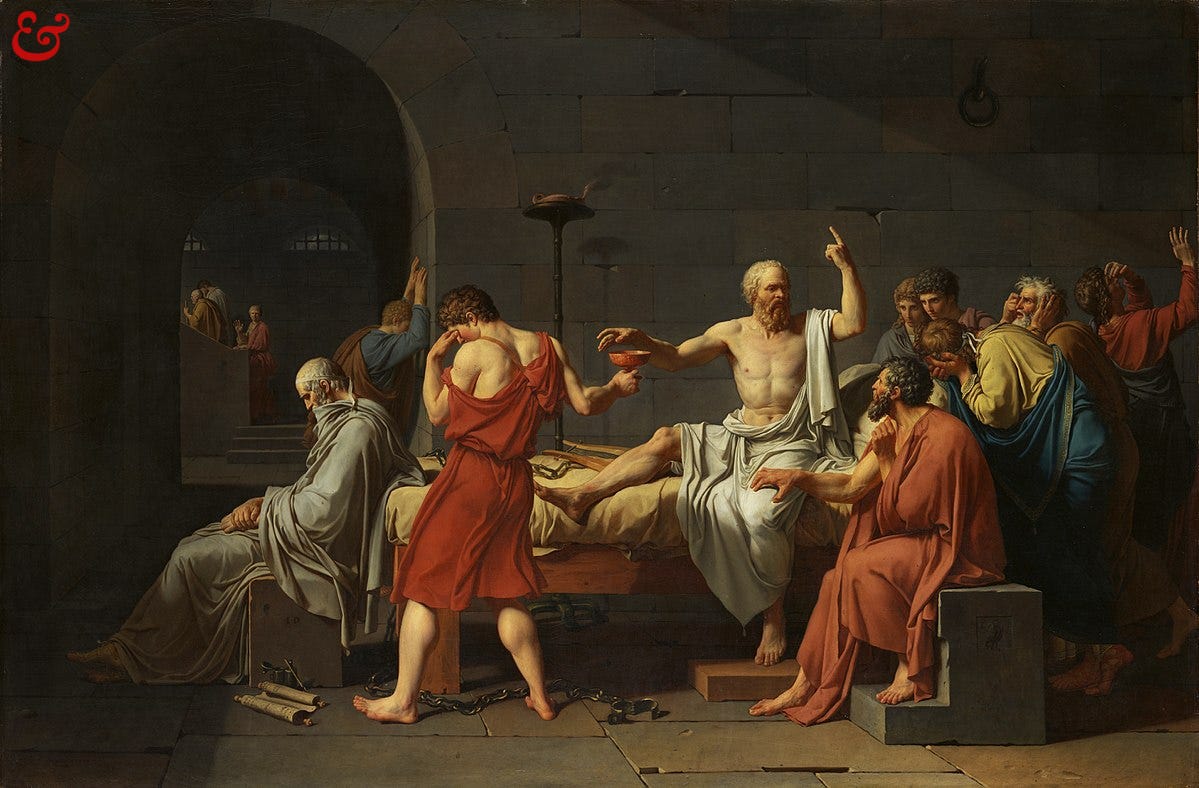
“The unexamined life is not worth living.”
— Socrates, 399 BC
Marc Andreessen, the billionaire venture capitalist and self-appointed philosopher-king of Silicon Valley, recently made a confession that he seemed to regard as a boast. He engages in “zero” introspection, he announced on a podcast — or “as little as possible.”
“If you go back, like, 400 years ago it never would have occurred to anybody to be introspective. Great men of history didn’t sit around doing this stuff.” 1
Self-examination, he explained, is essentially a Freudian invention, a fad dating from around 1910 that serious, productive people have no business indulging. The podcast host congratulated him.
You have to wonder if the host had ever heard of Delphi.
Ancient Wisdom, Forgotten
The injunction Know thyself was carved into the stone of Apollo’s temple there around 600 BC — a reminder that self-knowledge is not a therapy trend but the oldest instruction in Western civilization. Socrates built his entire life’s work around the idea, at considerable personal cost.
Marcus Aurelius, who managed an empire somewhat larger and more consequential than a venture capital fund, kept a private journal of relentless self-examination. You may have heard of it: it’s called Meditations.
Sun Tzu — a name every Silicon Valley operator claims to revere — wrote:
“It is said that if you know your enemies and know yourself, you will not be imperiled in a hundred battles; if you do not know your enemies but do know yourself, you will win one and lose one; if you do not know your enemies nor yourself, you will be imperiled in every single battle.”
This is, at one level, a failure of reading. But it is also something more instructive: a window into what happens when busyness becomes a philosophy.
Andreessen’s own account of his daily information diet makes the point without any assistance. He tweeted his perfect mix:
“1/4 X, 1/4 podcast interviews of the smartest practitioners, 1/4 talking to the leading AI models, and 1/4 reading old books. The opportunity cost of anything else is far too high, and rising daily.” 2
One wonders whether he reads those old books or simply asks the AI models for their summaries.
Here, at least, is an honest confession: not that introspection is worthless, but that he has arranged his life so as to make it structurally impossible. He could only hold this position in the present era — the only moment in history when the platforms he funds have made non-optional boredom effectively extinct.
He has not transcended the need for self-examination. He has simply paid for enough noise to drown it out.
The Fear Within Us
“Beware the barrenness of a busy life.” — Socrates
I’ve written before about the barrenness of the busy life — how our frenetic pace, our clogged inboxes, our back-to-back calendars become not just inconveniences, but evasions. 3
Kahlil Gibran understood this with uncomfortable precision:
“There are those among you who seek the talkative through fear of being alone.
The silence of aloneness reveals to their eyes their naked selves and they would escape.” 4
We seem, so many of us, to be running not merely to the next thing but running from ourselves. Andreessen has simply elevated that tendency into a manifesto and called it productivity.
But introspection, properly understood, is not rumination. It is not the mental doomscrolling of a mind that won’t let go. The word derives from the Latin for “looking within” — and its purpose is not to trap us in our heads but to liberate us from them.
The Connection Between Introspection and Empathy
Self-knowledge and empathy are not separate faculties — they are, in the deepest sense, the same faculty. To wall off one is to impair the other.
A person who practices zero introspection does not merely fail to know himself; he also loses the capacity to imaginatively inhabit the experience of others. 5
For most leaders, the cost of that loss is measured in missed feedback, poor decisions, broken trust. For someone of Andreessen’s reach — whose firm funds the technologies of war and surveillance, whose political influence shapes policy, whose investments touch millions of lives — the cost is measured in something considerably harder to audit.
“Zero introspection,” then, is not a productivity hack. It is, as David Futrelle aptly noted, “a permission slip for zero accountability.” 6
Self-Awareness is Accountability
Leadership, at its best, is an act of continuous self-correction. Leaders who never examine themselves cannot know where their blind spots are, cannot hear what they are not saying, cannot feel the distance between their stated values and their actual decisions. They are, in Gibran’s phrase, living in their lips — producing sound rather than thought, motion rather than meaning. 7
Socrates paid with his life for insisting that the examined life was the only one worth living. We need not go that far. But we might at least insist — for ourselves and for those who hold influence over others — that self-reflection is not weakness, not navel-gazing, not a Viennese indulgence. 8
It is the oldest form of leadership hygiene we have.
The world will not slow down to allow it. That is precisely why it must be chosen deliberately, defended stubbornly, practiced in the margins of a schedule that would otherwise consume every quiet moment.
The examined life isn’t optional. It’s the essential work beneath the work.
There’s so much to learn,

Examine more from our Archives:


“Reading Socrates in Silicon Valley: Self-proclaimed stoics who denounce self-examination only prove the bankruptcy of the tech bro worldview,” Jemima Kelly, Financial Times, March 22, 2026
Marc Andreessen on Twitter, March 9, 2026
“What You’re Missing by Constantly Running,” Timeless & Timely, June 1, 2022
The Prophet, Kahlil Gibran, 1923
Explore our sections on Empathy and Self-Awareness
“Marc Andreessen’s Dangerously Unexamined Life,” David Futrelle, The Nation, March 23, 2026
Also see our section on Accountability.
Lots to reflect on in the Reflection section of our topics.
Agree, I read and saw a few blurbs on this introspection thing parsed as supposed thought by him and I definitely have some of my own thoughts on this and reaction to his comments but I had to admit my first reaction was to laugh, to laugh at the complete absurdity of such statements. Another blaring example example of a person without any introspection on display (as if we need any more of them) and they perceive themselves and the world or the world they are trying to create introspection who needs any introspection and that imo is frightening enough in itself. Absolutely no real hindsight, foresight or wisdom either. Dare I even ask what could go wrong with that or that sort of binary thinking or should I even ask or should I just leave it to my own personal introspection. The quagmire of thought, introspection and wisdom when to use it or not to use it. I’ll always be trying to utilize mine personally for another if the no introspection thing is their thing I do believe it’s good to know that also.
Or how they see