

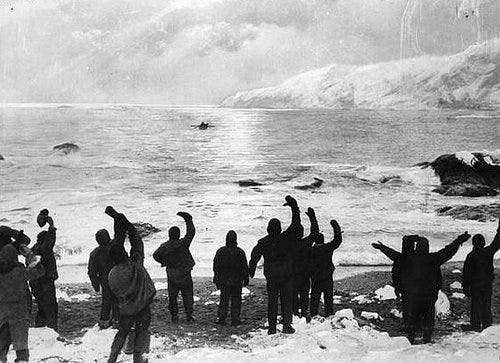
“Destitute as we are — and we are certainly very destitute now — I think we are better off than many poor folk at home.”
— Dr. Alexander Macklin, diary entry, Elephant Island, 1916
In the previous essay1, we arrived at an uncomfortable observation: coordinated behavior in any group emerges not from directives and broadcasts but from local attention. Each member of the flock watches its neighbors and aligns to what it sees.
Today I want to take you to a small, frozen, miserable piece of rock called Elephant Island, in the year 1916, and introduce you to a man named Frank Wild. You may not have heard of him. That is appropriate. The men who model behaviors well are usually outshone by the men who give better speeches.
Are We Going to Die Here?
In April of 1916, Sir Ernest Shackleton left Elephant Island in a 22-foot lifeboat to attempt one of the most audacious open-ocean rescues in maritime history — 800 miles across the Southern Ocean in winter. He left behind 22 crew members, the men of the Endurance, on a beach beneath two upturned lifeboats, with the unspoken understanding that he might never return. Command fell to his second-in-command, Frank Wild.2
Wild’s task was impossible. No way of knowing whether Shackleton had survived. No way of being rescued except by his success. Four months of waiting on a windswept rock with starving, frostbitten men and one question hanging over every conversation:
Is the Boss coming back, or are we going to die here?
He could not answer that question.
So he answered a different one, every morning, with his own behavior. He rose first. He rolled up his sleeping bag with theatrical optimism. He set a routine of small tasks — chores, sing-alongs, the reading aloud of cookbook recipes as evening entertainment. He cut hair.
He led the Saturday night toast to “sweethearts and wives” and clinked mugs with each man. He kept them so busy with the small business of living that they had no time for the larger business of despairing.
And the men watched him. They were not listening — they didn’t have to. He gave one short speech, the day Shackleton left, and never repeated it. They were watching the bird nearest to them, the only bird whose behavior would set their own.
“He set an example by being positive himself and being strong for the others, even in the most harrowing of circumstances.”
— Macklin’s diary
When the rescue ship Yelcho finally broke through the ice on August 30, 1916 — after four failed attempts, after the food had dwindled to four days’ worth — every single one of those 22 men was alive. Not a single one had died, not one had broken.
They had been a flock, and the bird in the middle had given them three rules every morning by the simple act of how he behaved.
They map to Reynolds’ observations.
Separation: he gave each man space to keep his dignity, never crowding them with reassurances he could not deliver.
Alignment: he oriented himself, visibly and consistently, toward the assumption that they would be rescued — and the men aligned to that heading because the bird closest to them was banking that way.
Cohesion: he kept the group close, the Saturday toast standing in not for sentimentality but for the bird in the middle saying, with his actions, we move as one or we do not move at all.
Three rules. Modeled and repeated, every day. No need for speeches. And the flock survived. Which leaves us with a question:
If your people were marooned on an ice floe and you were the only bird they could watch — what would you be teaching them about how to fly?
🔒FOR PAID SUBSCRIBERS🔒
The deeper dive continues below
The Largest Flock in Human History
Here is the part I owe to paid subscribers and to the times we are living in, and I will not soften it: we are currently training the largest flock in human history.

