

Surface Tension
Upon further reflection
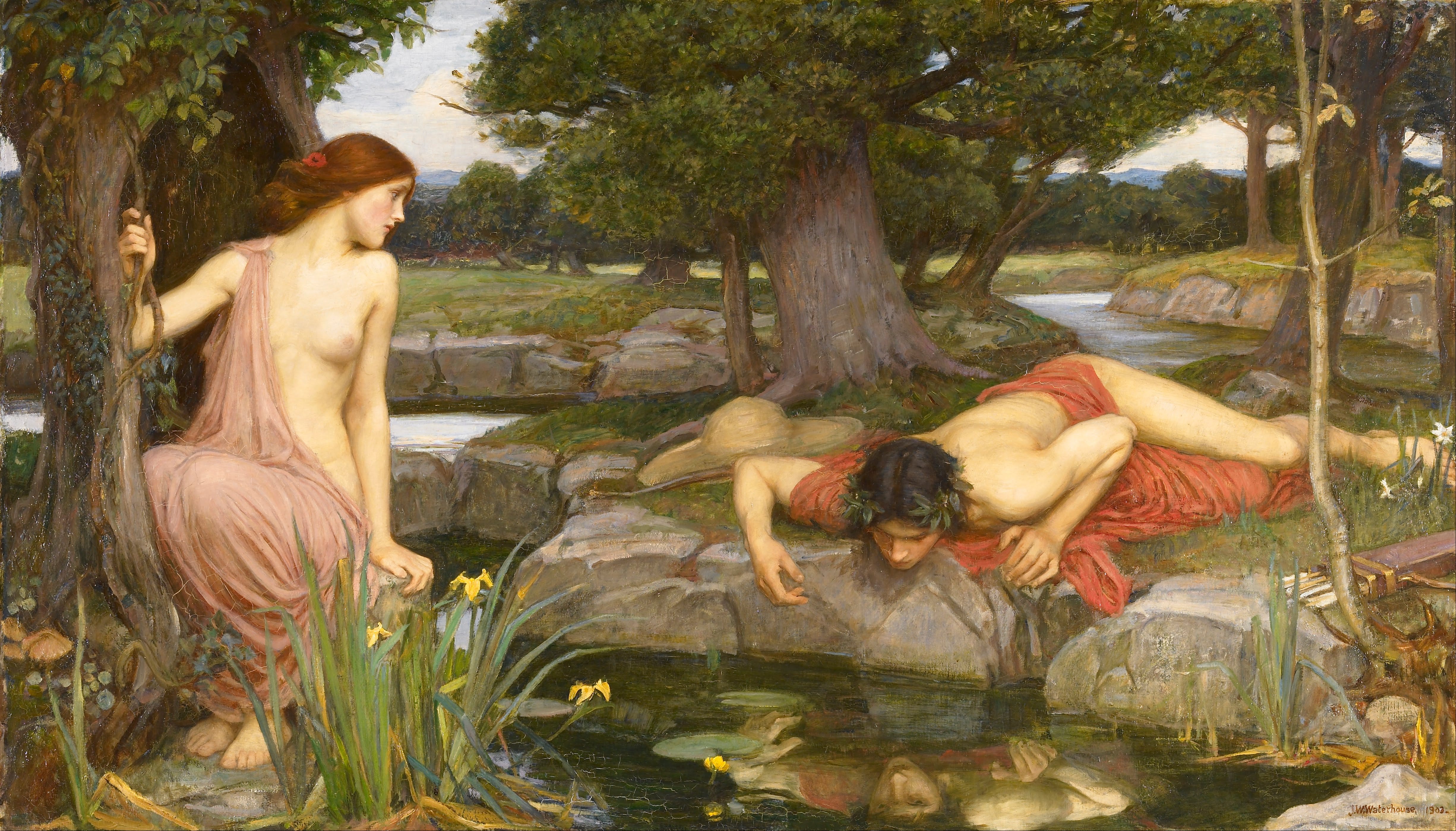
“He would live to a ripe old age, the prophet said — if he never came to know himself.”
— Ovid, Metamorphoses, c. 8 CE
In the image above, we see a boy leaning over the edge of a still pool. Near him, half-dissolved into the trees, stands the nymph who loves him and whom he will never bother to notice.
She is Echo, and she has lost the power to say anything of her own; she can only repeat the last words spoken to her. He is Narcissus, who has just been introduced to the most fascinating face he will ever meet and does not intend to be parted from it. He will keep the appointment until it kills him.
When Narcissus was born, his mother asked the blind prophet Tiresias whether the child would live a long life. The answer was one of those riddles the Greeks loved: yes — if he never knows himself. It sounds like a blessing. It was a sentence.
Above the temple of Apollo at Delphi the Greeks had carved their standing instruction to humans — know thyself.1 Tiresias simply inverted it. Narcissus would be ruined not by the failure to find himself but by finding only his reflection, and taking the reflection for the man.
The Two Reflections
Here is the thing the myth conveys and we forget. “Reflection” is one word doing the work of two ideas, and the two have almost nothing to do with each other. One is the image thrown back by a still surface — the face on the water. The other is the act of a mind turning to examine itself — the hard, unglamorous work of asking what we are doing and why.
Narcissus had an inexhaustible supply of the first and not a drop of the second. He studied his own features for the better part of a lifetime and came away knowing nothing, the water showing him everything except himself.
We have built a civilization fully fluent in the first kind of reflection and increasingly starved of the second. Our surfaces have never been more available to us: front-facing cameras, curated feeds, the endless little pools we carry in our pockets and consult during meetings, at red lights, and in the restroom.
What we are short of is the older discipline — the still hour, the examined purpose, the willingness to ask a question whose answer might cost us something.
A Pool on the Mall
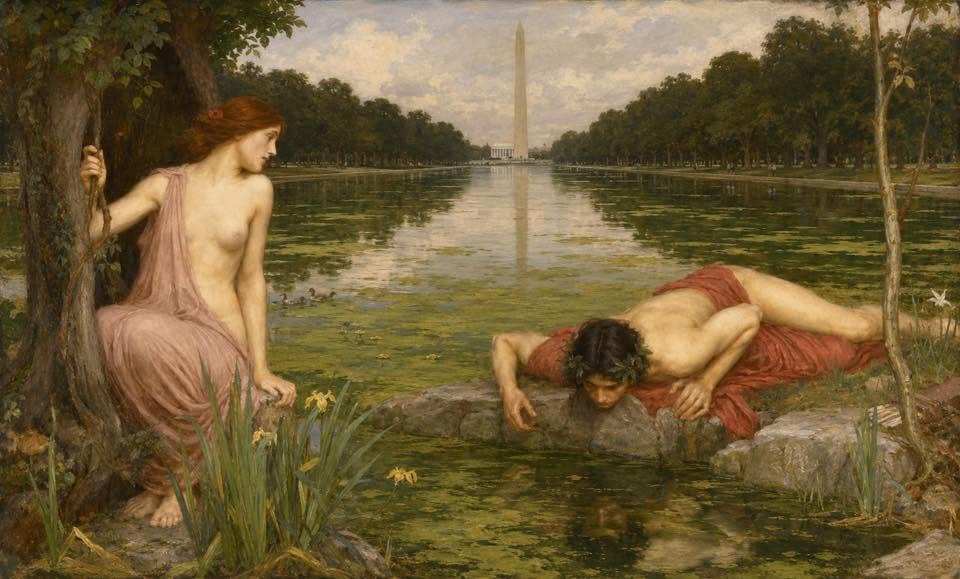
It would be hard to invent a tidier illustration than the one currently on offer in Washington. Ahead of the country’s 250th birthday, the Lincoln Memorial Reflecting Pool — the long, mirrored rectangle built to hold the image of the memorial and the monument beyond it — was selected for a makeover. The job was estimated at under two million dollars. It has since passed fourteen.
A narcissist obsessed with a reflecting pool is the peak of life imitating mythology.
The pool was drained and its already waterproofed concrete surface was repainted a patriotic blue with a substance that would not adhere to the treated concrete; algae turned it green; crews arrived with hydrogen peroxide and nanobubblers. The new paint began peeling off in strips and floating to the surface.
Asked to account for it, the man who ordered the work blamed vandals — unnamed, unevidenced — and countered his earlier claim that the surface couldn’t be cut with a knife by claiming the vandals used…knives.2

I raise it not to dwell on one man; the symbolism is too exact to ignore. A narcissist obsessed with a reflecting pool is the peak of life imitating mythology.
A reflecting pool is an instrument built to show you something other than yourself — the memorial, the sky, the obelisk at the far end. Fill it with your own image and you have produced, at considerable public expense, the precise condition Tiresias warned about: the pool that cannot reflect, commissioned by the man who will not.
Sophrosyne
The Greeks, who gave us Narcissus, also gave us the remedy, and they gave it a name we have unwisely let fall out of use: sophrosyne. It is usually rendered as “sound-mindedness,” though it gathers up a whole constellation — moderation, self-restraint, and above all self-knowledge: the capacity to know yourself and to know the limits of what you know.3
Heraclitus, around 500 BCE, called it the highest virtue of all. Plato described it as a kind of harmony among the parts of the soul. Its opposite is the quality that destroys Narcissus and a great many boards, cabinets, and command structures since: hubris — the overconfidence that has lost the ability to see itself.4
What makes sophrosyne so difficult is that it cannot be installed. It is not a trait you either have or lack; it is a practice, learned the way one learns an instrument, through repetition and a tolerance for being bad at it first. And the practice is reflection — the second kind.
The leader who reflects is doing what Narcissus never managed: turning away from the flattering surface long enough to ask the questions that don’t flatter.
I have written before that the best leaders ask a great many questions — not the bad-faith “just asking questions” that smuggles in a conclusion, but the genuine kind, the kind that leaves you open to an answer you didn’t want.5
That openness is reflection pointed outward. Pointed inward, it becomes the harder discipline still: the readiness to say I don’t know, to admit the thing isn’t working, to look into the mirror when the team is failing and consider that the problem might be standing in front of it.
Learned Self-Knowledge
The cost of skipping reflection is not borne by the leader alone; it is borne by everyone downstream of him.
This is not soft. It is the hardest thing leadership asks. When Alan Mulally ran Ford, the heart of his Working Together™ system was a weekly review called the BPR, in which executives marked their projects red, yellow, or green — and the only unforgivable move was to mark a failing project as green. We had to be honest with ourselves and each others.
The whole system existed to make self-knowledge mandatory, to keep a room of capable, ambitious people from gazing into the pool of their own competence and seeing only green (or American Flag Blue). “People first,” Alan would say — which is, when you think about it, an instruction to look up from your own reflection at someone else’s face.
“Look within. Within is the fountain of good, and it will ever bubble up, if thou wilt ever dig.”
— Marcus Aurelius, c. 170
Note the verb Marcus Aurelius used above. Not gaze — dig. The fountain is not the surface you admire; it is the depth you have to work to reach. Narcissus, had he ever stopped looking at the water and started looking into it, might have lived to the old age Tiresias dangled in front of him. Instead, he wasted away beside an image, and the gods, with their usual economy, turned him into a flower that bows its head toward the ground.

The cost of skipping reflection is not borne by the leader alone; it is borne by everyone downstream of him. Socrates, on trial for his life, offered the line that ought to hang in every executive suite: the unexamined life is not worth living. He might have added the corollary we keep relearning at greater and greater expense — unexamined leadership is not safe to follow.
An organization led by someone who cannot bear to look past his own surface will, sooner or later, find itself repainting the same pool, blaming the same phantom vandals, and wondering why the water keeps turning green.
It is easy, and a little too comfortable, to point at the figure on the Mall. The more useful exercise is to admit that each of us keeps a pool we would rather admire than see past — a flattering account of our own competence, our own motives, our own indispensability, that we consult the way Narcissus consulted his.
We can’t avoid the water entirely; that would be unrealistic. But when the water finally goes still, are you willing to look past your own face?
There’s so much to learn,
Further reading from the archive
Taking Time to Think It Through — know thyself before you gather the facts.
From Shame to Self-Awareness — the uses, and the side effects, of seeing yourself clearly.
Humility Can Seem Soft When Problems Are Hard — Odysseus, Polyphemus, and the price of self-assertion.
How to Make Reflection a Daily Habit — first published beneath this same Waterhouse painting, five years ago.
Also browse our sections on Reflection, Self-Awareness, and Emotional Intelligence.
Also known as “The Best Leadership Advice of All Time,” as discussed in Timeless & Timely on March 29, 2022.
“Trump Blames Vandals for Reflecting Pool Problems. Internal Records Tell Another Story. The documents do not indicate that the peeling blue coating and algae blooms were caused intentionally.” The New York Times, June 23, 2026
“Why sophrosyne, an ancient Greek virtue, matters more than ever in the age of AI,” The Conversation, June 5, 2026
Also see: “Emotional Intelligence and Ego,” Timeless & Timely, October 17, 2019. There we talked about components of emotional intelligence — namely self-awareness, self-discipline, empathy, and relationship management.
“Why Do Leaders Encourage Questions?” Timeless & Timely, October 19, 2022. The more we ask, the more we learn.