


Welcome to Sunday Journal, a chance to start your week out with short, quiet reflections and advice for life.
This effort started with a handwritten journal (a wonderful gift!) I keep for each of my children, designed to give them a sense of how to become the best version of themselves. If you find this valuable, please share it with others.
Each edition contains three sections: reflections to put into practice, an inspirational quote, and an image to contemplate.
In this edition, we pause to reflect on what really matters: how we treat ourselves, which determines how we show up for others.

Reflection
As Christmas looms, we hear about the spirit of the holiday, often made clear through the story of Ebeneezer Scrooge and the lessons of thinking of others. During this season of giving, when we spread joy to others, some simple truths to help keep us focused:
Happiness is an inside job ― it starts with you.
Instead of always looking to be blessed, spend some time being a blessing to others.
Don’t look for your soul in tangible things; look for it in the relationships you nurture.
The purpose of life is not to be happy — but to matter, to be productive, to be useful, to have it make some difference that you lived at all.

Quote
Two quotes this time — a holiday gift.
“I have wrought my simple plan
If I give one hour of joy
To the boy who’s half a man,
Or the man who’s half a boy.”
― Sir Arthur Conan Doyle, 1912
“One is only happy in proportion as he makes others feel happy.”
— Milton S. Hershey*

Image
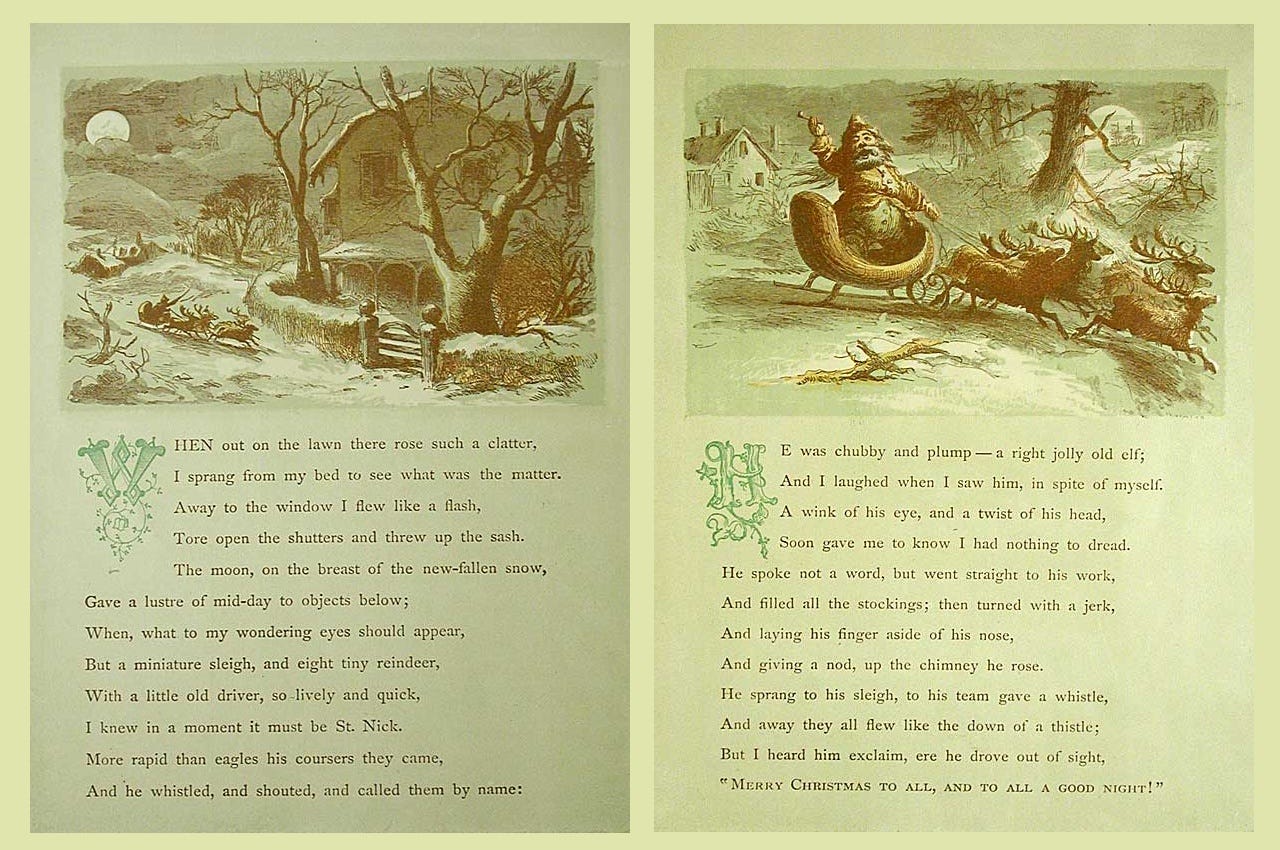
Two illustrations from Clement Moore’s poem “A Visit From Saint Nicholas, by Felix Octavius Carr Darley, published by New York, Hurd & Houghton, 1862 (via Library of Congress).
Clement Clark Moore wrote what are considered the most well-known verses in American poetry in 1823, which his friend submitted to the New York Sentinel anonymously. Moore would claim authorship in 1837.
His interpretation of Saint Nick was borrowed from his friend Washington Irving, whose A History of New York (1809) popularized the pipe‑smoking, sky‑riding gift‑giver Sinterklaas based on Dutch folklore. Instead of arriving on Christmas Day, Moore’s version made his visit on Christmas Eve.
His conception gave rise to many of the attributes we associate with Santa Claus today and was solidified through Darley’s illustrations, as well as those by Thomas Nast and others in the mid- to late-1800s. Later, in the 1930s the Coca-Cola Company used Santa in its Christmas advertising imagery.
There’s so much to learn,

*The Hershey quote was brought to our attention by the excellent publication The Rustbelt Reader.