

Profiles in Cowardice
Not making a decision is a decision.

“Nearly all men can stand adversity, but if you want to test a man’s character, give him power.”
— Robert Ingersoll, 1883
One of the stern lessons of childhood (mine, at least — maybe yours too) my parents drilled into me was: always try to do the right thing, even when it’s hard.
Typically, the more difficult scenarios involved making a decision to do what was right when my friends tempted and lured me in other directions.
Temptation is a shapeshifter, ranging from timeless vices like lust, greed, and gluttony to modern manifestations such as manufactured psychedelics, peer pressure, and doomscrolling through the news.
It can be hard to do the right thing when we’re tempted to do otherwise. And in that moment, it’s easy to forget how consequential your words and actions are when you’re a leader.
Leaders — people in power — are watched closely, their every decision and utterance scrutinized for deeper meaning. Or even actual meaning.
Your words have power. Even the slightest things you say, such as off-hand remarks or side-comments, are given greater significance because of who you are.
And when a crisis looms, all eyes are on the leader. How a leader decides to show up and what they decide to say or do in a critical moment says a great deal about their character.
Consider: what would you do if you were presented with an opportunity to speak up about an injustice or wrongdoing, even if it cost you your livelihood?
It was the topic of my discussion with Rick Wilson on Timeless Leadership:

But it was also a decision that Katherine Graham, publisher of The Washington Post had to make at one point.
Here gene weingarten summarizes the decision in “Courage and Cowardice”:
“On June 18, 1971, The Washington Post began publishing the Pentagon Papers at a time of extraordinary tension between the media and Richard Nixon’s occultly corrupt government. The decision had been made the day before by the only person with the power to do it: Katharine Graham. Printing the stolen material was possibly a felony. The New York Times had just been enjoined by a court from publishing the documents. It was not unlikely that Nixon’s Justice Department would seek criminal penalties from The Post for breaching that order.”
Even though the government wielded enormous power that could negatively affect her business, her job and her people, Graham decided to do the right thing.
“A half decade later, in the midst of the Watergate mess, this happened: Awakened from a drunken sleep by a phone call by Carl Bernstein, John Mitchell, the former attorney general of the United States, listened to Bernstein read the lede of yet another devastating story that would appear in the next day’s Post. “JEEESUS!” Mitchell screamed. “Katie Graham is gonna get her tit caught in a big fat wringer if that’s published.” The story was published, of course, and for years afterward, Mrs. Graham wore a specially-made necklace with two charms on it: A tit and a wringer.”
Her decisions in moments like these spoke volumes about her character and her values.

What can we infer about the values of modern-day publishers like Patrick Soon-Shiong of The Los Angeles Times and Jeff Bezos of The Washington Post, both of whom have declined to offer an endorsement of a presidential candidate in this particularly fraught cycle?
According to former Washington Post tech columnist Walt Mossberg, Bezos had nothing but admiration for Graham in 2016:
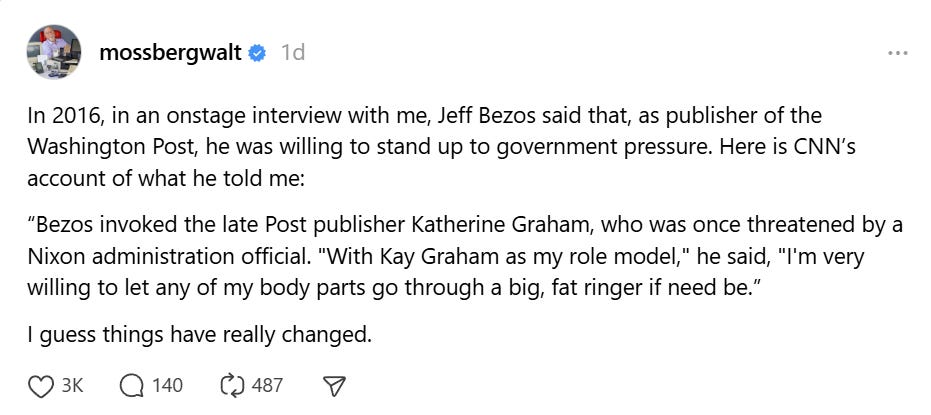
And Karin Klein, a now former member of the Los Angeles Times editorial board, wrote
“Soon-Shiong’s anti-editorial stance is actually a de facto decision to do an editorial—a wordless one, a make-believe-it’s-invisible one that unfairly implies grievous faults in Harris that put her on a level with Donald Trump. Soon-Shiong is, whether he realizes it or not, practicing the opposite of the neutrality he professes to seek.”
In other words, the silence was deafening.
Perhaps they’re trying to be more objective. Or maybe they want to protect their future interests (from a potential president who’s hell-bent on vengeance (I can’t believe I have to type that)).
Or maybe it’s a strategic business decision to get out of the endorsement practice entirely. In which case, the announcement should have come more than a week before such a consequential election.
Leaders, by virtue of their roles, can’t hide. They’re watched and scrutinized because the nature of their work places them in the limelight.
Their great power means they have outsized responsibilities — responsibilities that go beyond job descriptions and day-to-day functions.
As professionals and public figures, these publishers have a duty to the public. In fact, we talked about duty just last week:
