

Power Insulates, Silence Compounds
The hidden cost of leading without anyone who can tell you the truth


“No man is an island, entire of itself.”
— John Donne, 1624
There is a moment, somewhere on the ascent, when the view changes. The feedback softens, disagreements become rarer. The room adjusts to you before you enter it. At first, it feels like respect. Later, it begins to feel like something else entirely.
The lead article in the latest issue of The Atlantic1 by Nathan Hawley captures this essence. Hawley attended Jeff Bezos’ annual Campfire gathering in Santa Barbara: 80-plus elite guests at a bought-out resort, private jets dispatched to multiple cities, and nannies provided for every family in attendance.
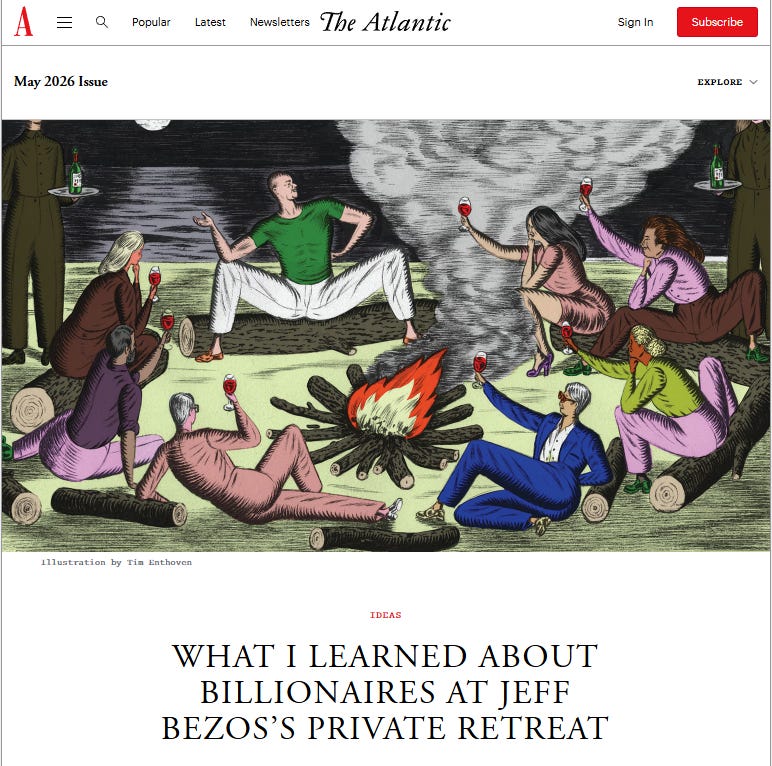
What Hawley discovered was a sense of disconnection from reality, a resort-sized walk-in closet of the emperor’s clothes, fully on display for no one to see:
“This is the hubris of accomplishment. To be declared a genius at one thing is to begin to believe you are a genius at everything.”
It’s a seductive delusion, and it is not limited to multibillionaires. It is the occupational hazard of anyone who has climbed far enough that the people around them have stopped telling the truth.

Deprivation
The scene at Campfire is painted as the world’s wealthiest men floating in “a sensory-deprivation tank the size of the planet, in which their actions are only ever judged by themselves.” Being truly rich, he argues, doesn’t mean owning superyachts or private jets. It means that everything becomes effectively free — and that nothing can ever genuinely be lost.
That is an extreme case. But the underlying dynamic — the progressive insulation from honest feedback, from consequence, from the unvarnished reality that other people represent — is not extreme at all. It is structural. It is built into the architecture of leadership itself.
The data are stark.
Nearly half of CEOs report feelings of loneliness and isolation, and 61% believe it directly affects their performance.2 And 26% of executives show symptoms consistent with clinical depression, compared to 18% in the general workforce.3
In a 2024 survey, 55% of CEOs experienced a negative mental health issue within the past year — a 24-point jump from 2023, the steepest single-year increase since the pandemic. And yet 81% of CEOs say that organizations typically view someone with mental health issues as weak or a burden.4
As the problems compounds in silence, you begin to think it’s you. It’s not.
“Loneliness kills. It’s as powerful as smoking or alcoholism.”
— Robert Waldinger, 2016
The Conflict of Interest at the Top
There is a reason this stays hidden, and it has nothing to do with weakness of character. It has to do with the structural reality of the corner office.
Direct reports manage up. Boards evaluate. Spouses protect. Friends don’t fully understand the weight. The result? The person with the most consequential decisions to make is often the person with the fewest people who can tell them the truth without a conflict of interest.
Enter the hidden business cost of leadership isolation: degraded decision quality, increased turnover, slower organizational performance.5
These aren’t soft, intangible costs. They show up in results.
The Solution That Isn’t Weakness
Here is what the research actually shows: 71% of CEOs who sought peer support reported improved company performance.6
Not improved feelings. Improved performance.
The antidote to leadership isolation isn’t therapy, though there is no shame in that. It is structured access to someone with no stake in the outcome — no direct reports to protect, no board seat to hold, no equity at risk — who can offer the honest perspective that the organizational chart systematically withholds.7
This is what executive advising and coaching, done well, actually is: a deliberate counterweight to the gravitational pull of the echo chamber that power creates around itself.
What’s more, our Working Together™ Leadership and Management System, created by my former CEO Alan Mulally and personally entrusted to me, helps to address this with honesty, transparency, and accountability grounded in principles of love and humility, and backed by data.
The result was a room where every voice had standing, every problem was surfaced, and no one had to perform confidence they didn’t feel.
Most organizations don’t have that room. Most leaders have never been in one.

The warnings are urgent, the numbers telling. Nearly half of the people running our most important institutions are lonely in ways that are measurably costing those institutions — and the people who depend on them.
The question is not whether leadership isolates. It does, reliably, at every level of the ascent. The question is whether you have built a counterforce to it — someone in your corner who is not of your world, who can see what the room has stopped telling you.
The view from the top can be clarifying. It can also be dangerously narrow, without the right counsel.
Let’s get you back on track.
There’s so much to learn,
“What I Learned About Billionaires at Jeff Bezos’ Private Retreat,” Nathan Hawley, The Atlantic, May 2026. Read it. It’s essential and enlightening.
“CEOs Often Feel Lonely. Here’s How They Can Cope,” Alaric Bourgoin, Sarah L. Wright, Jean-François Harvey and Saouré Kouamé, Harvard Business Review, December 23, 2024.
“Effects of a workplace intervention on daily stressor reactivity,” Kate A. Leger, Soomi Lee, Kelly D. Chandler, David M. Almeida, Journal of Occupational Health Psychology, 2022 Feb; 27(1):152-163.
“American Executives’ Mental Health Survey Findings,” Calm’s Executive Mental Health Study was conducted September 9-14, 2025, among an online sample of 253 C-suite executives.
“The Loneliness Premium: What Isolated Leaders Cost Their Businesses,” The Alternative Board, April 8, 2026
Hey, I know someone like that — someone who’s worked directly with a Fortune 10 CEO and has his enthusiastic endorsement.