

Nothing Beside Remains
We look on the works of Temu Ozymandias and despair
“Half sunk, a shattered visage lies, whose frown,
And wrinkled lip, and sneer of cold command”
— Percy Bysshe Shelley, 1818
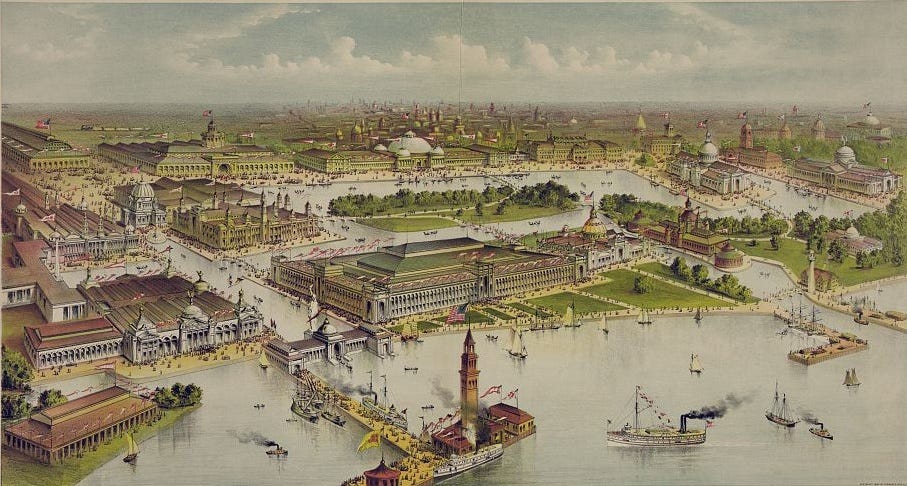
I was in Chicago last week, a few miles from Jackson Park, where a lagoon still traces the shoreline that once held the grandest lie in American history.
You wouldn’t call it that now. What’s left is dignified: the Museum of Science and Industry sits exactly where Daniel Burnham’s Palace of Fine Arts stood — one building of the 1893 World’s Columbian Exposition1 that was solid enough, and important enough, to be built to actually last.
Everything else is grass now, and geese, and the quiet of a Chicago afternoon. It’s hard to conjure the 27.5 million visitors who came to see a city that rose from a swamp in 22 months and that vanished within two years of opening.
They Came for the White City
Burnham, with Frederick Law Olmsted laying out the grounds, built fourteen “Great Buildings” around a Grand Basin, each dressed in the vocabulary of Rome and the Renaissance. A Scottish travel writer called it “the most flawless and fairy-like creation, on a large scale, of man’s invention.”
At night, thousands of electric bulbs turned the basin to gold. It wasn’t merely a fair. It was an argument: that a young, sooty republic could conceive of order and beauty on a scale to rival anything Europe had built in a thousand years — and do it in 22 months, from nothing.
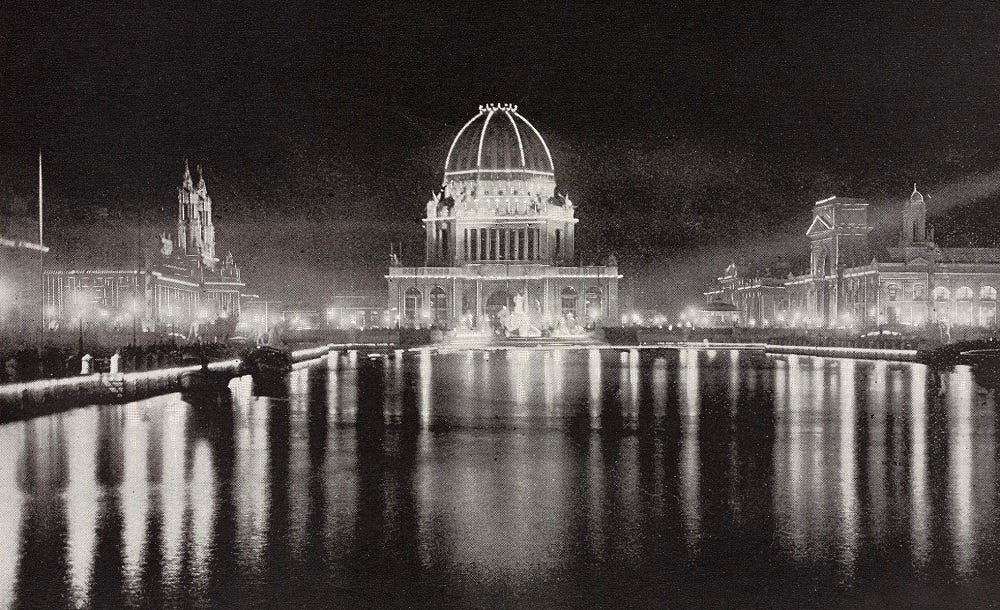
That argument outlived the fair. Out of the White City came the City Beautiful movement,2 the Art Institute of Chicago, the Museum of Science and Industry, and, in the most peculiar circularity of this story, Washington DC’s National Mall itself.
In 1901, Burnham sat on the Senate Park Commission alongside three colleagues from the fair, and together they redrew L’Enfant’s plan for Washington into the grand, axial space that exists today.3 The very lawn on which a very different spectacle recently unfolded owes its shape to Daniel Burnham’s ambition.
Direct Deceit in Service of Ambition
I say ambition, and not honesty, deliberately, because the White City was, physically, a lie. Those fourteen buildings were never marble. Their façades were constructed of “staff” — plaster, cement, and jute fiber over wood, painted white to mimic stone. Critics called them “decorated sheds.”
Louis Sullivan, a mentor of Frank Lloyd Wright, worried the fair’s classicism would damage American architecture “for half a century from its date, if not longer.” John Ruskin, forty-four years earlier, had already passed sentence on exactly this maneuver:
“The intermediate shell were made of wood instead of stone, and whitewashed to look like the rest — this would, of course, be direct deceit, and altogether unpardonable.”4
By his own lamp of truth, the White City fails inspection. It was theater, held up by timber, sold as permanence.
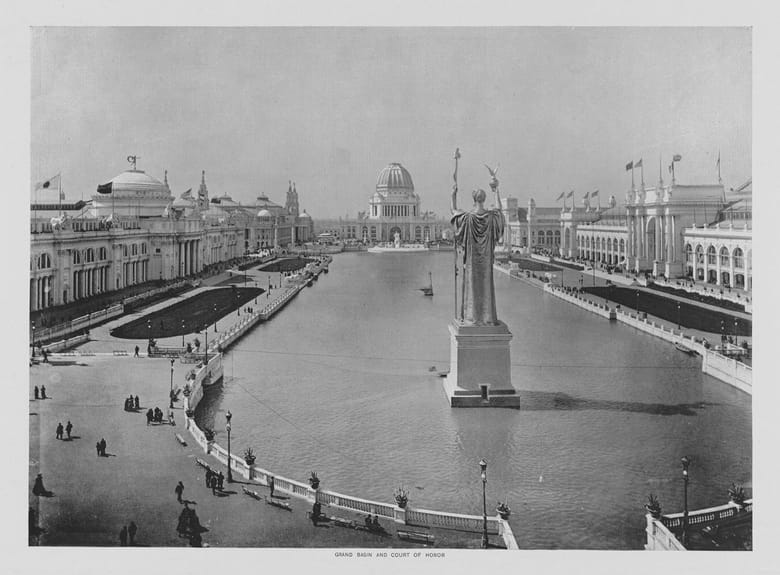
And yet history — which is not obligated to be consistent, only honest about what it rewards — was generous to that particular lie. Because the lie wasn’t really about the plaster. It served an idea large enough to survive its own props: that a nation could aim at greatness and be judged, eventually, on what it actually built once the scaffolding came down.
Burnham said as much himself, seventeen years later, in a line quoted past the point of cliché but still earning it:
“Make no little plans; they have no magic to stir men’s blood and probably themselves will not be realized. Make big plans; aim high in hope and work, remembering that a noble, logical diagram once recorded will never die, but long after we are gone will be a living thing, asserting itself with ever- growing insistency. Remember that our sons and grandsons are going to do things that would stagger us. Let your watchword be order and your beacon beauty.”
The plaster was a promissory note. It got cashed — the World Congress Auxilliary building became the Art Institute of Chicago, the Palace of Arts was transformed into the Museum of Science and Industry, in a stave church shipped back to Norway in 2015 having outlived two world wars and the country that hosted it.5
Which brings me, reluctantly, to a fairground on the National Mall.
The Fair-to-Poor State Fair
I won’t recount the news at length; you’ve seen it, and the facts satirize themselves better than I could. The Great American State Fair — Donald Trump’s contribution to the nation’s Semiquincentennial, cast in his own image of gimcrackery and cheap ornamentation, attempting to appear authentic — is staged this June on the same lawn Burnham helped design
It opened to power outages, a Confederate flag controversy, and crowds thin enough that every attempted fawning by certain media outlets was belied by visual evidence of how empty it was. A plywood-and-vinyl mockup of a proposed $100 million “Triumphal Arch,” planned to stand taller than the Lincoln Memorial, began wrinkling and separating at its seams within days. Reporters compared it, not unkindly, to the collapsing Stonehenge prop in This Is Spinal Tap.
Plaster with a Purpose vs. Plywood with None
Burnham’s staff dressed up a real argument about American ambition; the hastily assembled Semiquincentennial celebration scrapped a nearly decade-long Congressionally-approved, Smithsonian-backed set of plans that would have resulted in a grandeur that was intended to rival the 1976 Bicentennial celebrations.
Instead, it is reflective of the conceptually vague plans, lack of expertise, inattention to detail, and poor execution for which this administration is becoming notorious.
When Ozymandias demanded future generations look on his mighty works and despair, his error was building a monument to the appearance of greatness instead of the substance of it, expecting the desert not to notice the difference.
The more uncomfortable parallel isn’t architectural. It’s Russian, and it’s a lie about a lie.
It Takes a Potemkin Village
The phrase “Potemkin village” comes down to us as settled fact: that Grigory Potemkin built fake portable settlements along the Dnieper in 1787 to fool Catherine the Great, disassembled overnight and floated downriver to be admired again. It’s a wonderful story.
It is also, by the consensus of historians who’ve actually gone looking, almost certainly untrue — a defamation campaign cooked up by a Saxon diplomat who wasn’t even present, laundered into respectability 60 years later by a French travelogue trading in exactly the caricature its readers wanted. Potemkin decorated real towns along the route. But he didn’t hide that he was doing it.
I find this more damning, not less. It means the lie we tell about liars has outlasted the liars themselves. We built ourselves a myth to condemn deception with, and the myth has proven sturdier than most of the buildings involved.
That’s the real inheritance of a summer that gave us a fairground of plywood and a 240-year-old rumor still doing honest work as an idiom. The species that erected Burnham’s plaster city in 22 months is the same species that has spent two centuries retelling a story about villages that were never actually built.
Where does that leave us?
Not with the easy verdict that appearances lie and substance tells the truth. Appearances aren’t the enemy; dishonest appearances are. Burnham’s staff and stucco were about as flimsy as this year’s plywood arch — the difference was never the material. It was whether the builder believed in something large enough to be worth the deception, and whether, once the props came down, anything was left standing that could survive an honest inspection.
A White City evaporates and leaves us with a handful of buildings.
A Potemkin village — real or invented — leaves us nothing but the rumor of its own dishonesty.
And a vinyl arch, celebrating a nation’s 250th birthday, sends a message that the builder thinks the audience is dumb (with a ‘b’) enough to believe the lie and miss the obvious metaphor for how appearance is being sold over substance — the great irony being that even the appearance itself is shoddy.
An honest builder and a con man use the same materials. The only test history ever applies is what remains standing once the scaffolding is stripped away and no one is left to applaud.
Burnham bet his plaster on an idea worth building twice — once in temporary glory, once, later, in stone. That bet is the whole difference between a legacy and a rumor.
Ask yourself, honestly, which one you’re building — not this year, but with the parts of your life and work that will still be standing after everyone watching has gone home.
There’s so much to learn,

This might also interest you
Charlie Pappas was fascinated with world’s fairs and similar large-scale events — particularly with their proclivity to introduce new ideas and new products to the public. He compiled a series of significant ones in his book Flying Cars, Zombie Dogs, & Robot Overlords: How World’s Fairs and Trade Expos Changed the World. (Amazon | Bookshop.org)
Read more about the event, the architects and the legacy at World’s Columbian Exposition, Wikipedia. And for a superb experience with plenty of artifacts, photos and more, visit the delightful site worldsfairchicago1893.com.
City Beautiful movement, Encyclopedia Britannica
See the series of images from the L’Enfant-McMillan Plan of Washington, DC, Washington, District of Columbia, DC, Library of Congress)
Also see “Washington Has Been Carefully Planned for Two Centuries,” The New York Times (gift article)
The Seven Lamps of Architecture is an extended essay, first published in May 1849 and written by the English art critic and theorist John Ruskin. The ‘lamps’ of the title are Ruskin’s principles of architecture, which he later expanded in the three-volume The Stones of Venice. They are Sacrifice, Truth, Power, Beauty, Life, Memory, and Obedience.
The 7 Surviving Structures of the 1893 World’s Columbian Exposition, Neil Gale, Historian, The Living History of Illinois and Chicago Community
I appreciated this context a lot. It's become another mortifying spectacle--and I find it really weird how trump stages a garish UFC fight one week and then erects a neoclassical arch facsimile a couple of weeks later. He wants to have it all I guess. One of your lines that struck me most is this: "Appearances aren’t the enemy; dishonest appearances are." Anyway again thanks for the historical context; the 1893 fair was spectacular. I remember reading about it in Erik Larsen's eerie (2003) "Devil in the White City"....
Yep. Thanks for saying it so well. We will overturn effects of our king Midas.