

Last One Off
Courage was never about escaping danger; it’s about who you take with you.
“Who lives in fear will never be a free man.”
— Horace, 19 B.C.
We don’t hear enough about virtues these days. Or at least, we don’t see them practiced regularly enough. I’m not sure which is worse…
Ancient philosophers outlined the four cardinal (or classical) virtues — states of mind and character — wisdom, justice, self-restraint, and courage. Courage typically gets the most attention, given how easy it is to recognize it (or the lack thereof).1
A certain maritime disaster (no, not the one you’re thinking of) framed the ultimate expression of courage that still resonates today, and it’s worth a reflection.
While easy to express in hypotheticals, practicing courage can be difficult in real-life situations, when faced with decisions that affect our standing. More than a phrase uttered with bravado, it’s a willingness to take a risk and put ourselves in harm’s way in service to others.
Leaders may feel entitled to the extra protections and perks that such a position might command, but in reality, leadership is about paying a debt on behalf of those we serve.
Human Nature on the High Seas
The phrase “women and children first” is a familiar one. It’s not a maritime law, but a law of human ideals; it has been hailed as a moral imperative in disasters since the 19th century.2
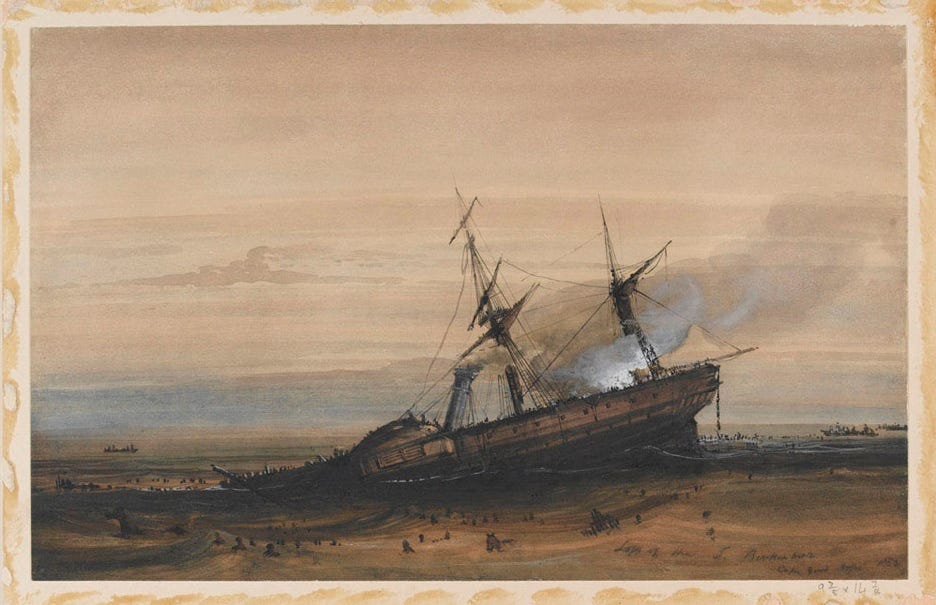
The incident that made this common practice happened in 1852: the British troopship HMS Birkenhead struck a hidden shoal off the coast of South Africa at 2:00 am on February 26 and began to sink. There were 638 souls on board, including soldiers, sailors, and 26 women and children.
Despite the crisis, calm and order prevailed as troops helped women and children board the lifeboats. Although two more boats were manned, one was immediately overwhelmed by water and the other could not be launched due to defective winches, leaving just three boats available for the soldiers and crew.
As the ship’s commander Captain Salmond watched the ship break up, he shouted “All those who can swim, jump overboard and make for the boats!” But Colonel Seton of the 74th Highland Regiment called on his soldiers to “Stand fast!” He knew that if they attempted to reach the lifeboats, they might endanger the passengers.
Instead, they kept ranks and went down with the ship in shark-infested waters. Some drowned, others were killed by sharks. There were 193 survivors out of 638 passengers and crew; all of the women and children were saved.
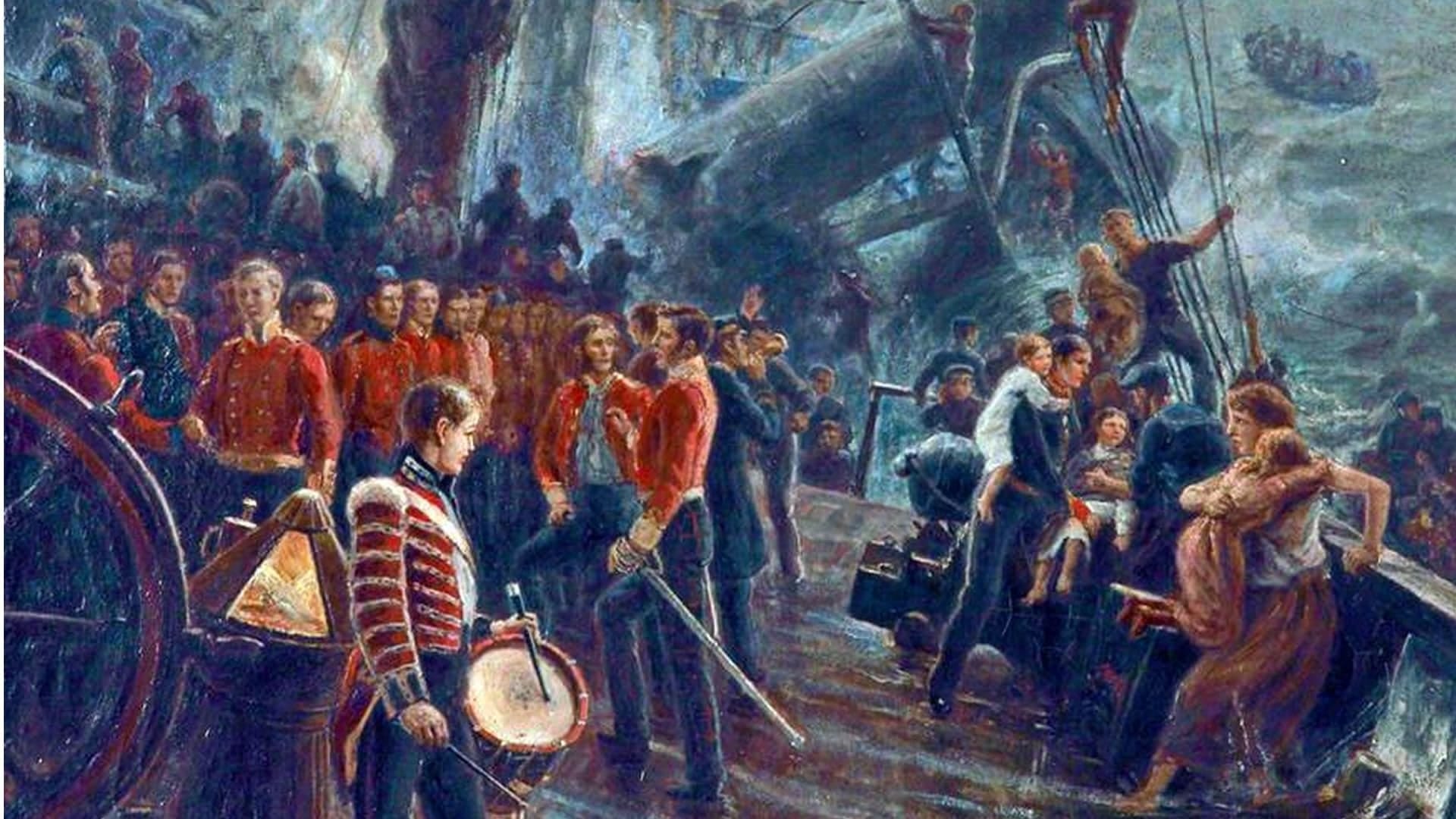
“The order and regularity that prevailed on board, from the moment the ship struck till she totally disappeared, far exceeded anything that I had thought could be effected by the best discipline... Everyone did as he was directed and there was not a murmur or cry amongst them until the ship made her final plunge — all received their orders and carried them out as if they were embarking instead of going to the bottom.”
— Captain Edward Wright, 91st Argyllshire Highlanders Regiment, 1852
This became known as “the Birkenhead Drill.” A related protocol is “the captain goes down with the ship,” popularized with Captain Edward Smith’s decision on board the Titanic.
Decoys or Sitting Ducks
One might think the same applies in the air as well as on the sea.
On July 8th, 2026, President Trump arrived in Ankara, Turkey for a NATO summit. He flew aboard a new Boeing 747 — a gift from Qatar that had been hastily pressed into service as Air Force One. U.S. intelligence identified a credible Iranian threat against him.
“We use every tool at our disposal, including distraction and misdirection.”
Here’s what happened next: a catering truck, the kind that services in-flight meals, pulled up to an exit door on the far side of the plane, out of view. The president and a small circle of aides climbed aboard, were lowered to the tarmac, and were driven to a separate aircraft which took off for the United Kingdom. The traveling press corps and members of his own White House staff were left behind on the original 747, now flying as an unwitting decoy after they boarded believing the president was on the plane with them.3
Nobody told them otherwise. Nobody informed them they were the ones left at risk after the target had been transferred off the aircraft.
There may be a case for secrecy in matters of presidential security — indeed, the press corps are frequently held to secrecy. “Often there are embargoes, so the information isn’t released until the president is safe, but Trump and his team ditched the press entirely,” according to Tamara Keith, a White House correspondent for NPR.4
Communications Director Stephen Cheung, when asked about the decision, seemed to give away the administration’s broader communications strategy: “We use every tool at our disposal, including distraction and misdirection.”
Even if that distraction and misdirection endangers their own colleagues, evidently.
Where the Air Meets the Water
You undoubtedly recall the “Miracle on the Hudson” — when US Airways Flight 1549 lost both engines after hitting a flock of geese on January 15, 2009.
Captain Sully Sullenberger made the decision to land the plane in the Hudson River because navigating to Teeterboro Airport in New Jersey or back to LaGuardia in New York were both impossibilities in a quickly descending plane that was gliding on air power alone. The plane landed smoothly, passengers used emergency exits to stand on the wings and float in inflatable slides as ferries rushed to rescue them. Not a single life was lost.
But there’s one detail in this already amazing story that isn’t widely shared. After the plane came to a rest in the river, Captain Sullenberger stayed behind. He walked the length of the plane once to confirm it was empty, and then a second time, as it took on the frigid water of the Hudson, to be certain. Only then did he leave the aircraft.
No one ordered him to do that. There’s no FAA regulation that required it. He did it because he genuinely cared about those in his charge.
“Courage is resistance to fear, mastery of fear — not absence of fear.”
— Mark Twain, 1893
And this demonstrates the difference. Those soldiers on the Birkenhead, Captain Smith on the Titanic, Ernest Shackleton and his 800-mile journey in a lifeboat in hurricane forces, Captain Sullenberger — all of them lived with fear, just as any one of us would.5
However, they refused to be paralyzed or stopped by fear. The made the decision to power through and to ensure the safety and survival of others, as a leader would do. They were put to a test of their personal integrity.
How do you think you would hold up? Would the person you are under pressure match the person you claimed to be beforehand?
Now consider the inverse: a man, who, faced with the same test, quietly arranges his own exit and lets everyone else discover the danger after the fact.
It’s reminiscent of this scene from The Boys:
Leadership Demands Courage
We have patience for leaders who fail under pressure; it happens all the time. But when they build the emergency exit before the crisis arrives and assign risk to innocent bystanders — like a golden parachute for an executive while employees suffer layoffs — our sympathies vanish.
Leadership without courage is a mirage. With it, even imperfectly, we see that we’re capable of something more than tactics and calculated transactions — that virtue exists beyond expedience.
Courage, as Twain wrote, is not the absence of fear, but its conquest. It is not the guarantee of safety, but the embrace of risk. It is the solitary moment in which a person chooses duty over comfort, truth over silence, conscience over complicity.
And if civilization is to endure, it is less dependent on our way with words than on the conviction of our actions — for without that, every other virtue is a bystander.
There’s so much to learn,
But don’t fret! We have an entire section on Courage. You can also browse all of our topics.
The exhibit “Women and Children First” from the National Army Museum has artifacts from the ship as well as the full story of the disaster and its aftermath.
“With Trump Secretly Evacuated, Imperiled Air Force One Became a Flying Decoy,” The New York Times, August 11, 2026 (gift article)
“Trump’s Plane Swap Ruse,” Up First, August 12, 2026
As told previously in these pages in “Resilience and Determination,” describing the difference between two Antarctic expeditions that had very different endings.