

It’s the Attention Economy and We’re All Broke
We inhabit an age in which the thing we most desire — uninterrupted attention — is the one thing we can no longer afford to give.


“Choice of attention—to pay attention to this and ignore that—is to the inner life what choice of action is to the outer. In both cases man is responsible for his choice and must accept the consequences.”
— W.H. Auden, 1973
The modern world insists that time is our scarcest resource. It isn’t. Time keeps going whether we notice it or not.
Attention, by contrast, is finite, fragile, and deeply revealing. What we give our attention to becomes our life. What we withhold it from slowly disappears.
To give someone — or something — your full attention is not a minor courtesy. It is an act of care.
Economists have been telling us for decades that we inhabit an “attention economy,” but the phrase understates the stakes. Attention is not merely traded; it is consumed.
Platforms compete for it, algorithms harvest it, and entire business models depend on keeping it fractured. The result is a culture rich in stimulus and poor in meaning.
Proximity without Presence
Research bears out what experience already teaches. Studies on multitasking and task-switching consistently show that divided attention degrades comprehension, decision quality, and memory.12
What we call multitasking is usually rapid context-switching, and the cognitive toll is steep. Each switch exacts a tax on working memory and focus.3 We feel busy, but we grow shallow.
Other research points in a more hopeful direction. When people experience genuine, sustained attention — particularly in conversation — trust rises.4 Psychological safety improves, retention of information increases, and being listened to attentively doesn’t merely feel good; it changes behavior. People think more clearly when they are truly heard.
This should not surprise us. Long before neuroscience entered the conversation, philosophers understood attention as a moral faculty.
Simone Weil called attention “the rarest and purest form of generosity.” William James argued that an education which improves attention would be “the education par excellence.” They were not speaking metaphorically. They were describing a discipline — one that forms character.
In our personal lives, attention is the scaffolding of relationships. Children learn who they are by noticing where adults place their gaze. Partners measure devotion not by declarations but by presence. Friendships endure because someone was willing to stay with a thought, a story, a silence.
Proximity without presence, however, has become the dominant condition of modern life. We sit together while scrolling elsewhere. We half-listen, waiting for our turn to speak — or for the next interruption. The body is present; the mind is absentee. Over time, this quiet erosion produces loneliness in plain sight.
Leadership suffers the same fate.
Attention, Uninterrupted
In organizations, attention is strategy masquerading as courtesy. Leaders who pay close attention see emerging risks before they metastasize. They hear dissent before it calcifies into disengagement and before morale erodes.
Study after study shows that employee engagement correlates strongly with the perception that one’s manager is genuinely attentive — not available in theory, but present in fact.
Yet many workplaces are designed to prevent attention from ever settling. Consider the many meetings that could have been emails, emails that could have been Slacks, and the multiple Slack channels that proliferate. Leaders mistake responsiveness for effectiveness, thinking motion means progress. The result is not alignment, but exhaustion.
Here the research on focus and “deep work” becomes instructive. Sustained, uninterrupted attention is strongly associated with higher-quality output, faster learning, and more original thinking. The work that matters most — strategic planning, creative synthesis, moral reasoning — cannot be done in fragments.
It requires stillness and interruption-free time, treating attention almost as a sacred object. The cost of ignoring this truth is not merely lower productivity. It is the loss of agency.
When attention is perpetually hijacked, we become reactive rather than reflective. We respond instead of choosing.
Distraction Takes a Toll
Consider the current state of the never-ending news cycle. Our anxiety is rising not because the world is more dangerous, but because the mind is never allowed to rest in one place long enough to make sense of it.
This is the deeper danger of distraction: it flattens thought. A culture trained on endless interruption loses its taste for complexity, patience, and depth.
The long view gives way to the trending topic. Wisdom yields to immediacy.
Attention Requires Intention and Boundaries
“My experience is what I agree to attend to. Only those items which I notice shape my mind — without selective interest, experience is an utter chaos.”
— William James, 1890
Attention is not something we either possess or lack. It is something we practice.
Practicing attention does not require retreating to a monastery or renouncing technology. It requires intention. Single-tasking rather than stacking. Turning off notifications when presence matters most. Creating rituals that protect uninterrupted time — for thinking, listening, reading, and making sense of what we already know.
It also requires boundaries. Attention, like any valuable asset, must be defended. If everything demands it, nothing deserves it. Choosing where not to place attention is as important as choosing where to invest it.
Hold the Mirror Up to Nature
Ultimately, attention is a mirror. It reflects what we value more accurately than our mission statements or our self-descriptions. We become what we repeatedly attend to. Our relationships, our work, our inner lives all bear the imprint of that choice.
In a civilization engineered for distraction, the decision to pay full attention is quietly subversive. It resists commodification. It restores dignity.
It reminds us and those around us that we matter enough to be noticed.
Attention is the most valuable resource you have because it is the one thing no one can give for you.
Spend it wisely.

Remembrance of Things Past
Samuel Johnson argues for the art of forgetting: “If useless thoughts could be expelled from the mind, all the valuable parts of our knowledge would more frequently recur, and every recurrence would reinstate them in their former place.” (Lapham’s Quarterly)
Can Listening to Classical Music Help Make You Smarter?
No, but… listening to classical music while you’re working can help increase your focus. The mathematical patterns provide just enough mental stimulation to keep your brain engaged without pulling your attention away from your work. (Our Heritage of Classical Music)
Cultivating Attention Through Slowness
I’ve been spending time with Matthew Long’s Beyond the Bookshelf, which is kind of an online reading club. Over the last year, he covered The Iliad and The Odyssey, reflecting on one book of each epic poem a week; his recent observation captures why this pace works:
“This enforced slowness cultivated a kind of attention that extends beyond reading into other areas of life—a willingness to be patient with difficulty, to trust that meaning will emerge through sustained engagement rather than immediate comprehension.” (Beyond the Bookshelf)
Related: You might want to check out the Patience and Trust sections of Timeless & Timely available in our archives.

The Multi-Trillion-Dollar Battle for Your Attention Is Built on a Lie
Real attention cannot be measured with a stopwatch or an app, and real attention — human attention — is far deeper and more complex than the ability to get stuff done. The attention economy “has exactly nothing to do with our human ability to give our minds and senses to the world. Rather, it is the name the authors give to a mathematically precise way of computing and ranking information in complex data sets.” (The New York Times — gift link)
CEO Focus is the Scarcest Resource
The average Fortune 500 CEO’s attention span during strategic decision-making sessions has dropped from 12 minutes in 2000 to just 4.7 minutes in 2024. More alarmingly, executives spend only 23% of their waking hours in what researchers call “deep cognitive engagement”—the mental state required for complex problem-solving and strategic thinking. The remaining 77% exists in a state of reactive, fragmented processing. (Dr. Raul V. Rodriguez)
Direction, Momentum, Control
“The way you spend your time determines what it is you walk away with.” (Leader to Leader)

My friend Eli Singer has a book out — Offline.now: A Practical Guide to a Healthy Digital Balance. It’s more than a book; it’s a community to help you reset your habits and rethink your relationships with technology. The key is understanding how motivated you are to change and how confident you are in your ability to make it happen. Check out Offline.now and take the simple two-question quiz to see how you might move forward.
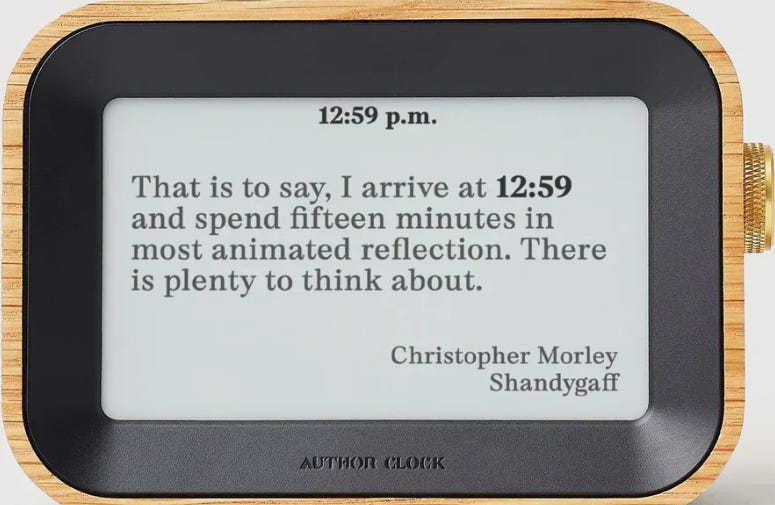
If we want to focus on the time, Author & Co. gives us a better way to do it: a clock that tells time through literary quotes, with a new hand-picked passage every minute of the day. It’s the Author Clock.
And one, just for fun:
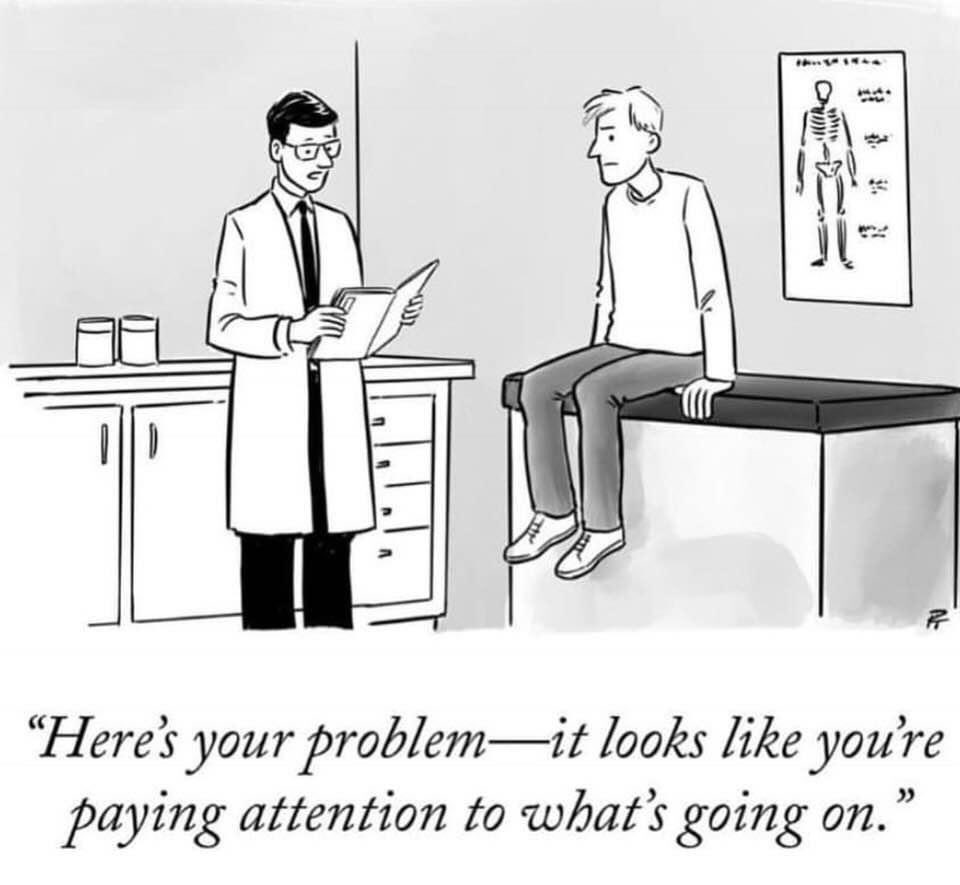
There’s so much to learn,

Logie, R. H., Trawley, S., & Law, A. (2011). “Multitasking, working memory, and remembering intentions.” Psychologica Belgica, 51(1), 35–54. Shows that concurrent task demands impair prospective memory and working-memory–dependent intentions, even when participants choose when to switch.
Weissman, D. H. et al. (2021). “Dividing attention influences contextual facilitation and revision during reading.” Journal of Experimental Psychology: Learning, Memory, and Cognition, 47(5), 742–764. Dividing attention during reading impaired both comprehension and memory-based facilitation in sentence processing.
Rubinstein, J. S., Meyer, D. E., & Evans, J. E. (2001). “Executive control of cognitive processes in task switching.” Journal of Experimental Psychology: Human Perception and Performance, 27(4), 763–797. Frequently summarized in APA materials as showing that switching between tasks produces measurable time and error costs, which grow with task complexity and unfamiliarity.
Mikkelson, A., Tietsort, C., & Hinnenkamp, C. (2024). “Employee Perceptions of Supervisor Credibility: Predictive Effects for Employee Well-Being Outcomes.” Business and Professional Communication Quarterly, 0(0).
“Our anxiety is rising not because the world is more dangerous, but because the mind is never allowed to rest in one place long enough to make sense of it.”
So true. Great points all around. And of course my reading of this was interrupted by a text message.
Sigh