

Holding On
The watch keeps the time; our love doesn't have to
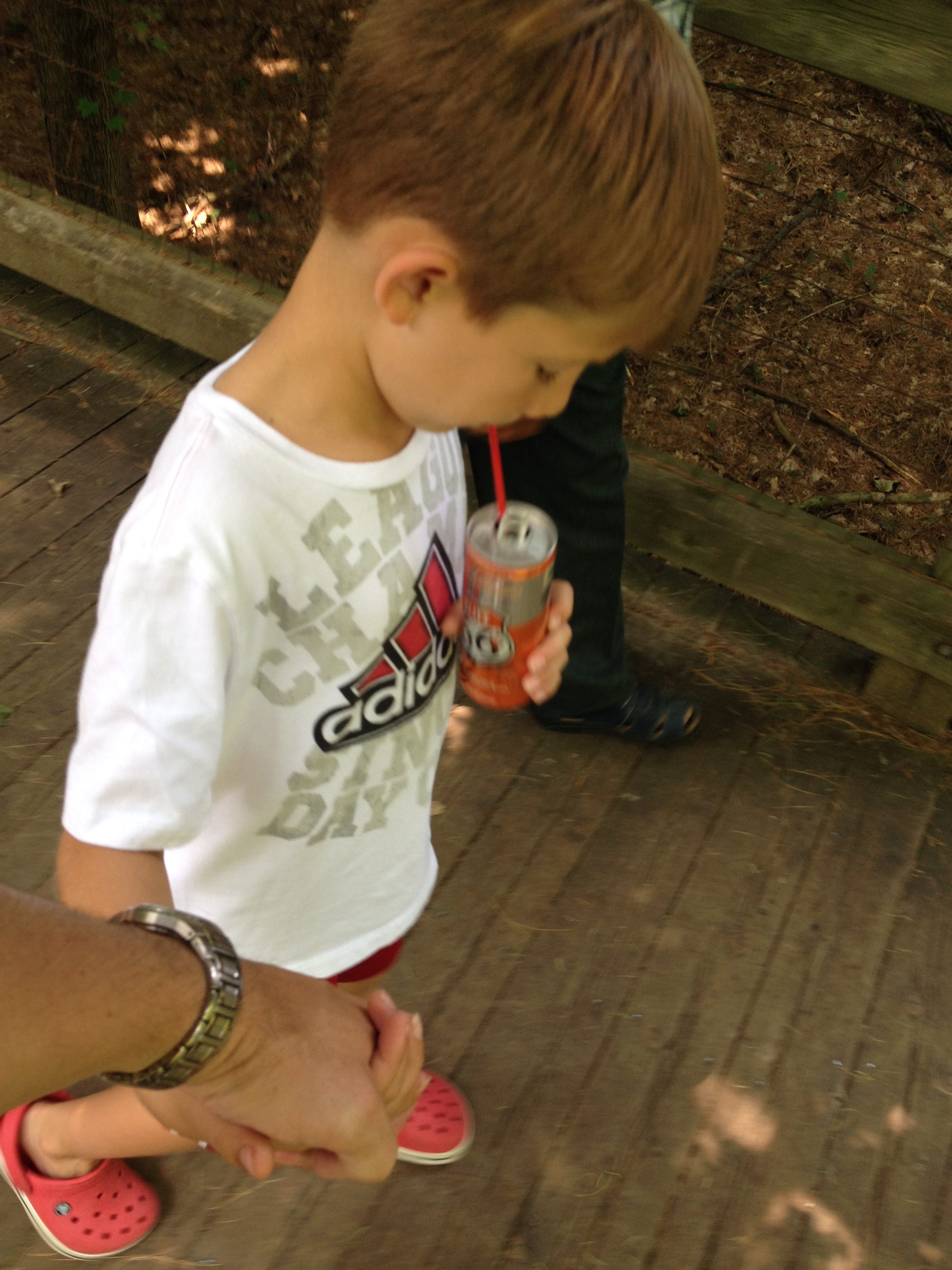
Look at the photograph above. My hand — a man’s hand, a watch strapped to the wrist, marking off minutes we didn’t yet know were numbered — wraps entirely around his. He isn’t looking at me. He’s looking down at a can in his other hand, a red straw balanced between his lips, already somewhere else. Below us: weathered boardwalk, leaves scattered along the rail, a pair of watermelon-print Crocs he’d outgrow before the summer was over.
I snapped it twelve years ago, when my younger son was eight, walking together on an ordinary day I didn’t know was extraordinary.
I knew, even then, that a day was coming — not far off — when he’d no longer want to hold my hand. Not because he stopped loving me. Because little boys grow up. Because independence calls to them, and their peers’ opinions start to matter more than their father’s hand around theirs. I was that way. You probably were too.
Looking at that photo now, I notice something I missed at the time: he wasn’t looking at me even then. His attention was already somewhere else — a can of juice, a red straw, the small immediate world in front of him. I held on anyway. That’s most of what parenting turns out to be.
“Your children are not your children. They are the sons and daughters of Life’s longing for itself. They come through you but not from you, and though they are with you yet they belong not to you.”
— Kahlil Gibran, 19231
You think you’ve outgrown what looks like a childish show of dependence and affection.
What I know now: our connection to others matters more than what anyone thinks of us. Adolescents will always weigh outside opinion heavily — that’s just how it is. But we can still show them there’s no shame in loving out loud, whether it’s a friend, a family member, or a colleague.
Caring about others is the foundation every relationship is built on.
To love and to be loved — in that order — is the purpose of life.
My son and I hug frequently now. We say “I love you” without thinking twice about it. And some part of me knows we’ll hold hands again someday — though it’s more likely to be his hand closing around mine, at the end, rather than the other way around.
The watch is still running. The boardwalk is probably still there, somewhere in those woods. Those watermelon Crocs didn’t make it to the next size.
There’s so much to learn,

P.S.
I help executives and companies understand that love and humility are key aspects of leadership and growth. I speak and consult on Our Working TogetherTM system, as created and shared with me by former Ford and Boeing leader Alan Mulally.
“On Children” is a poem that is part of In Kahlil Gibran’s The Prophet. In it, he shares profound insights on children, emphasizing that “Your children are not your children. They are the sons and daughters of Life’s longing for itself.” He encourages parents to recognize that children have their own thoughts and destinies, stating, “For their souls dwell in the house of tomorrow, which you cannot visit, not even in your dreams.” Gibran’s message highlights the importance of allowing children to grow as individuals, rather than viewing them as possessions