

Common Sense at 250
Sentences held an army together once. It's worth asking what they hold together now.
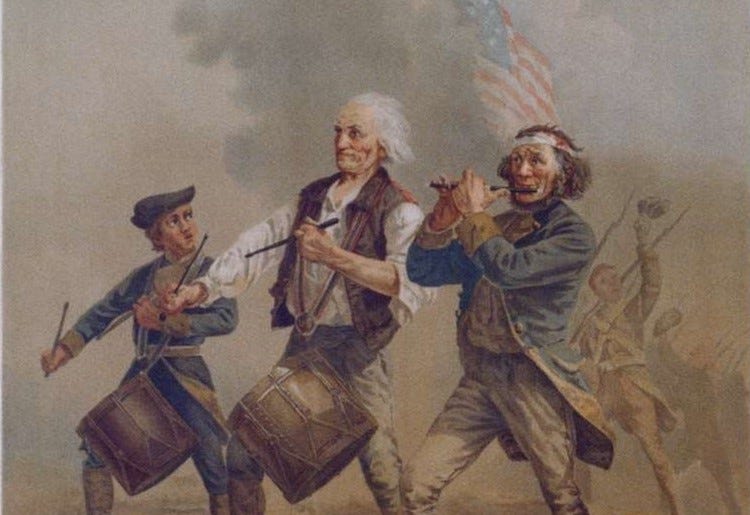
“An army of principles will penetrate where an army of soldiers cannot.”
— Thomas Paine, 1798
In the autumn of 1774, a 37-year-old Englishman stepped off a ship in Philadelphia carrying a letter of introduction from Benjamin Franklin and little else. He had failed at corset-making, failed at tax collecting, and left behind a second marriage that had just collapsed. No fortune. No family name. Nothing that would have qualified as a credential in that age.
Fifteen months later he published a 47-page pamphlet that reached a larger share of the colonial population than anything printed before or since. Thomas Paine’s Common Sense1 worked because of an assumption embedded in every sentence: that the tradesmen, farmers, and printers who read it could be reasoned into a conclusion they had not yet reached. Paine presented his position with arguments, not flattery, and made a good case in doing so.
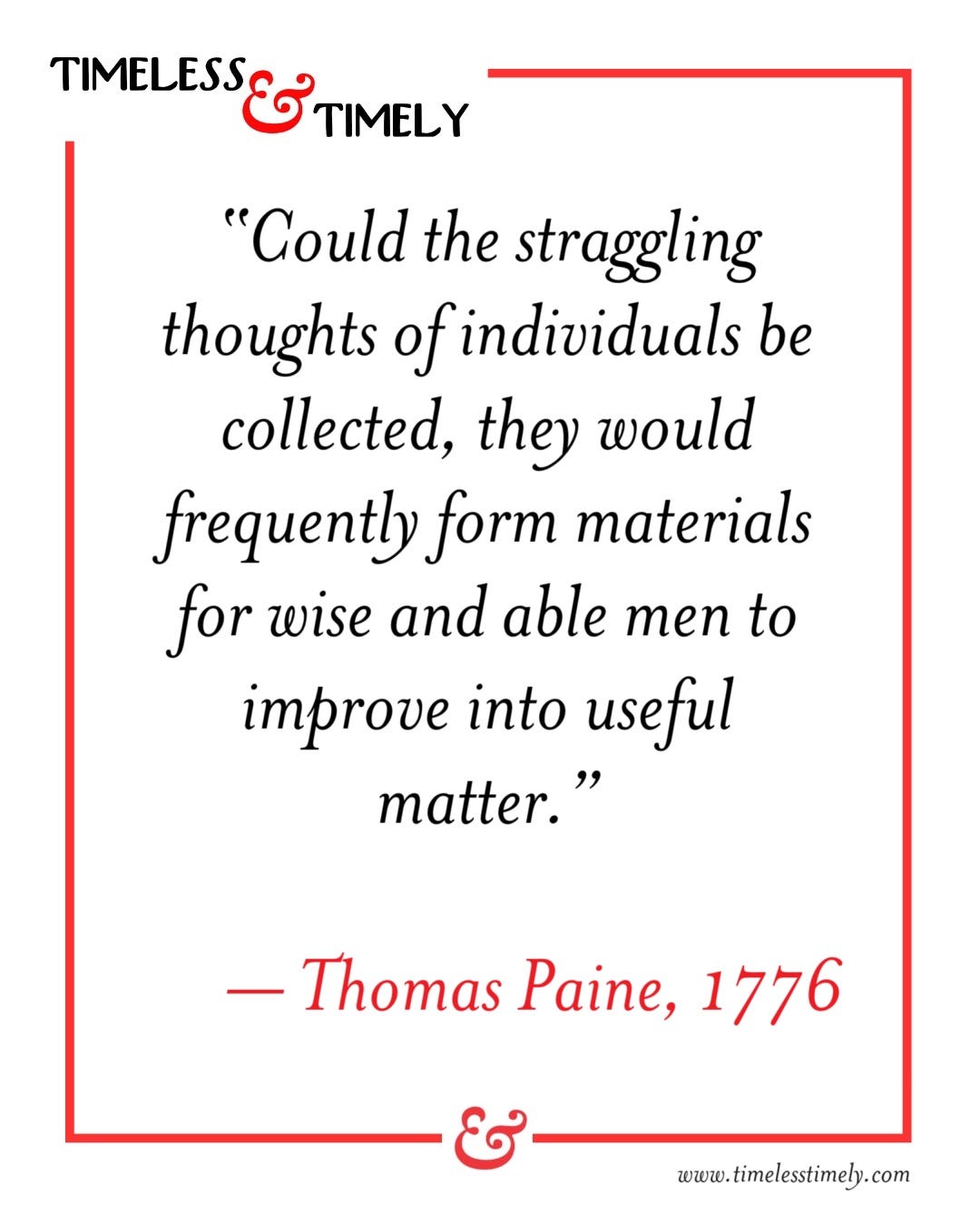
“Could the straggling thoughts of individuals be collected, they would frequently form materials for wise and able men to improve into useful matter.”
— Common Sense, 1776
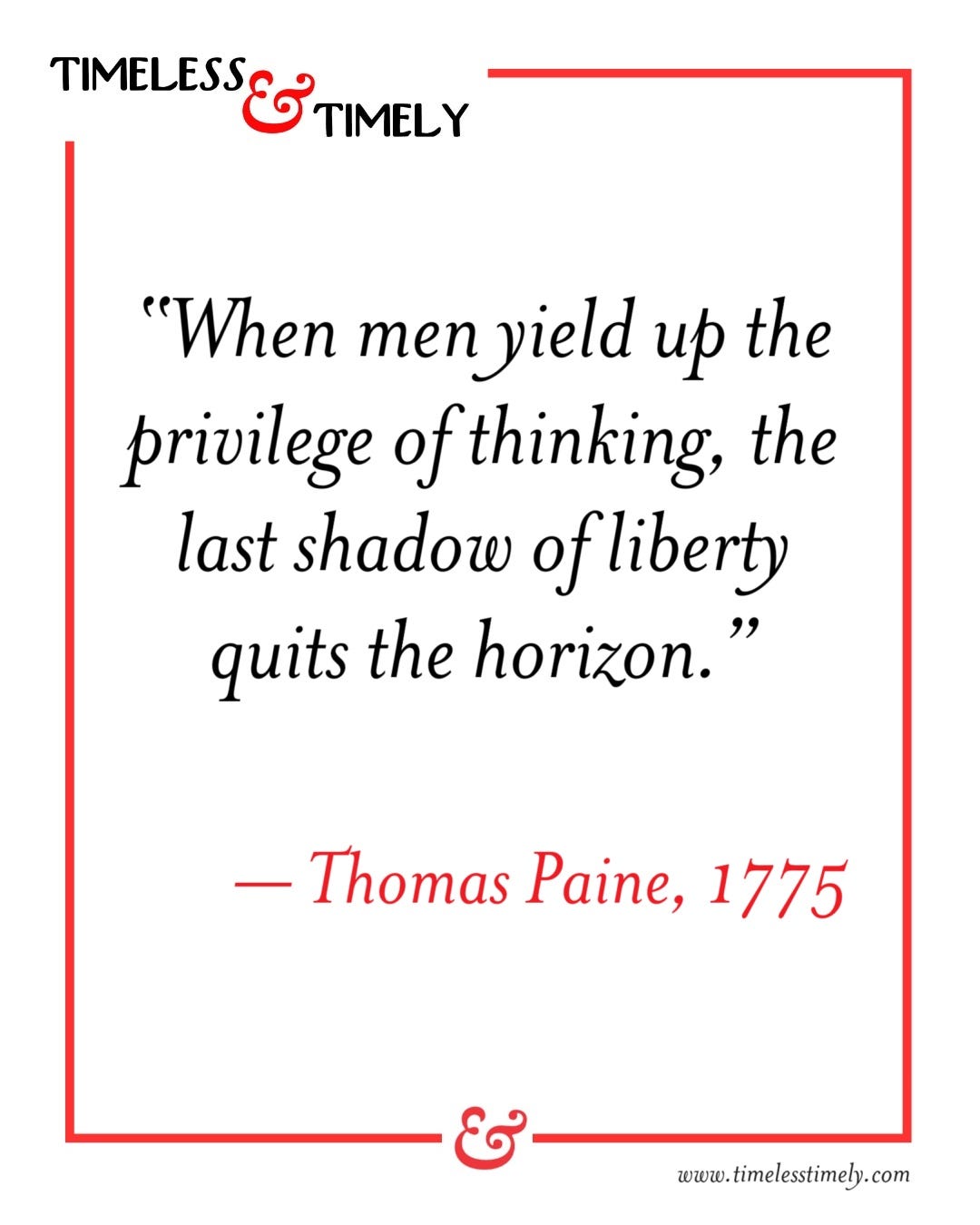
He had tested the method a year earlier, writing for the first time under his own name in “Reflections on Titles,” where he staked liberty itself on the willingness to keep thinking:
“When men yield up the privilege of thinking, the last shadow of liberty quits the horizon.”
— Reflections on Titles, 1775
By December 1776, argument alone would not hold the army together. Washington’s forces were disintegrating at their encampment on the Delaware — desertions running into the thousands, enlistments expiring at year’s end. Paine, who had marched with the retreat from New York, wrote The American Crisis in the days before Christmas. Washington had it read aloud to what remained of his men.
“These are the times that try men’s souls… the harder the conflict, the more glorious the triumph.”
— The American Crisis, 1776
Whatever combination of those sentences and that river crossing accomplished, it held the army together long enough to win at Trenton. A pamphlet did that. Not artillery — sentences.
Two hundred and fifty years on, we still like to say that words can hold something together. The question worth asking this particular Fourth of July is whether we believe it the way Paine did — or whether we’ve quietly stopped expecting an argument to change anyone’s mind at all.2
The Manufactured Consensus
“Self-evident” truths are rarely self-evident. Jefferson’s Declaration and Paine’s pamphlet did not discover a consensus already latent in the colonial mind — they built one, through careful rhetorical construction, timed publication, and relentless argument.
The Enlightenment’s great confidence trick was persuading an audience that the conclusion they had just been argued into had actually been there all along, waiting to be recognized. That is not a knock on Paine. It is an accurate description of what persuasion is: not the discovery of pre-existing agreement, but the patient construction of it.
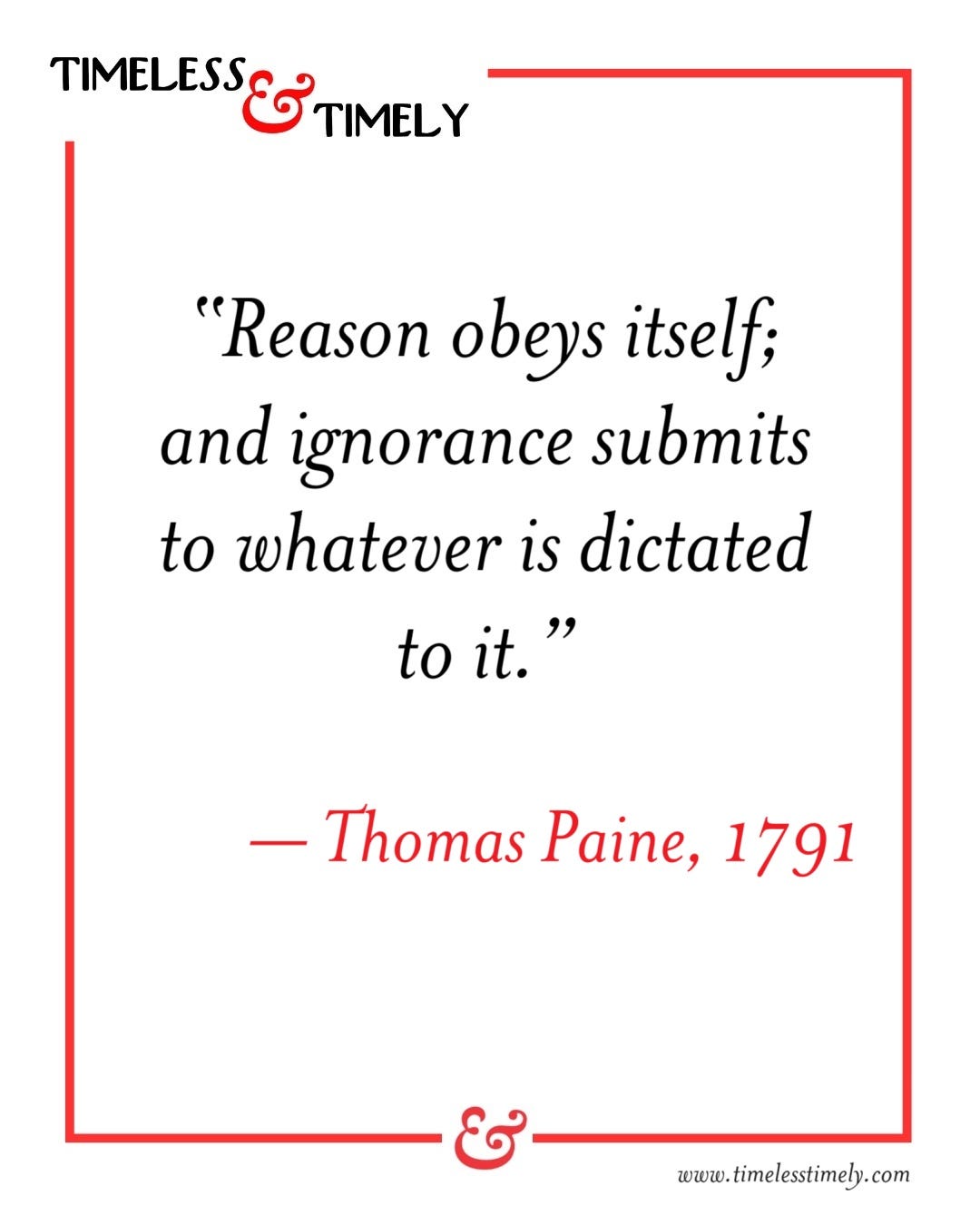
Paine kept making that bet through less flattering weather. In 1791, defending the French Republic in a stance that cost him friends and eventually his freedom, he still insisted that a reasoning mind deserved to be reasoned with:
“Reason obeys itself; and ignorance submits to whatever is dictated to it.”
— The Rights of Man, 1791
By 1794, imprisoned in Paris and drafting The Age of Reason under threat of the guillotine, he turned the same instrument on religious falsehood, in a line that reads like it was written for a Tuesday in our own news cycle:
“It is an affront to treat falsehood with complaisance.”
— The Age of Reason, 1794
Consider that word: complaisance. Paine is not describing he who issues a falsehood — he is describing the audience that lets the lie pass, out of a preference for comfort over friction. That is the exact posture an engagement-optimized feed, or a fluent language model, will always reward in us, because it’s easier to accept that which encourages our beliefs rather than challenges them. And so we scroll past.
The Truth About Truth
We walked this same ground three years ago in “The Truth About Truth” — the observation that we go on believing con men not because we are fooled, but because we want to be led somewhere by someone smarter than us, and only feel betrayed once the bill comes due. Paine’s readers wanted the opposite of that. Not to be led, but to be convinced. That distinction is the entire difference between a demagogue and a pamphleteer, and it is disappearing from our information diet at precisely the moment it is most worth protecting.
By 1798, exiled in Paris and mostly written off by the country he had helped found, Paine made his last and most confident claim for the method that had carried him that far:
“An army of principles will penetrate where an army of soldiers cannot; it will succeed where diplomatic management would fall.”
— Discourse to the Society of Theophilanthropists, Paris, 1798
He was, by then, poor, unpopular, and largely ignored. History has been kinder to the claim than his contemporaries were to the man. Principles did outlast the armies that carried them in 1776 — but only because enough people were still willing to write, and read, as though minds could be changed by something other than volume or velocity.
That is the inheritance actually worth marking at 250 years — not the fireworks, the fairs, or the hamburgers, but the harder discipline underneath them: the willingness to argue rather than assert, and the humility to assume your reader is capable of following you there.
The pamphlet is gone. The obligation it created is not.
What would it cost you this week to write, or lead, or argue as if the person on the other end could still be persuaded — rather than simply captured?
No Paine, no gain.
There’s so much to learn,

In January 1776, the War of Independence was already well underway, but Common Sense helped galvanize and solidify many of the ideas that fueled this movement. The impact of Common Sense was certainly felt, six months later, when the Declaration of Independence was signed on July 4. Common Sense continues to influence political discourse to this day.
See Paine’s Collected Writings: Common Sense / The Crisis / Rights of Man / The Age of Reason / Pamphlets, Articles, and Letters (Library of America)