Welcome to “Off the Clock,” a little something that lands somewhere between Timeless & Timely.
I send out this fun look at language and words every other Saturday as bonus content. If someone sent this to you, please consider subscribing.
This one is free, so if you like what you see:
“As great minds have the faculty of saying a great deal in a few words, so lesser minds have a talent of talking much, and saying nothing.”
— Francois de la Rochefoucauld
Hello, fellow word nerd.
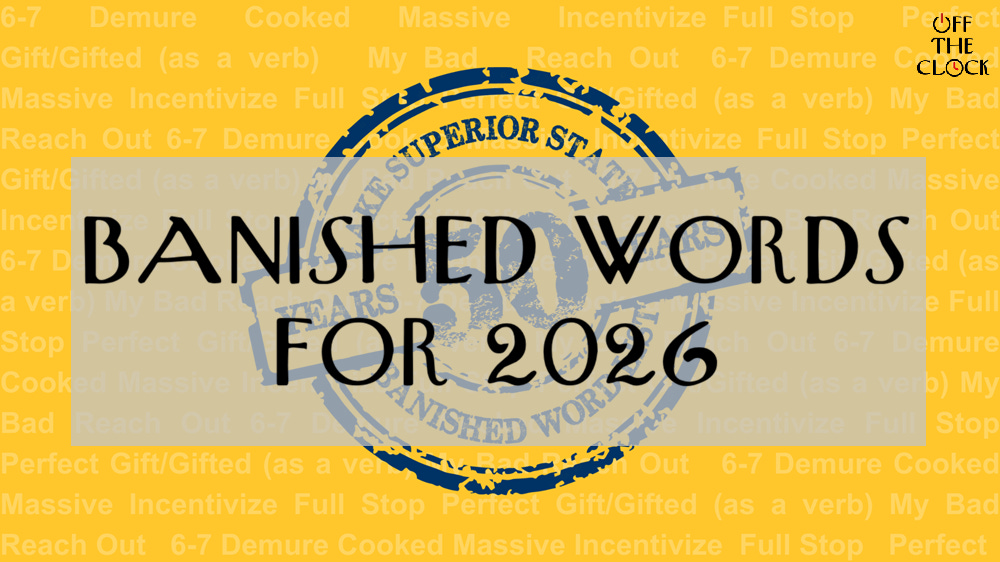
Well, it’s that time of the year once again. The glorious season of the release of the Banished Words List.
This annual tradition, started by a fellow Baker Street Irregular and kinsprit Bill Rabe at Lake Superior State University, is now marking its Golden Anniversary — that’s right, the list has been around for 50 years.
If you’d like some history of this list and Bill’s creative brain, we have an exclusive interview with his son John:

Meanwhile, for the rest of us who want to know which of our friends require needling, here’s the 2026 version of the annual List of Words Banished from the Queen’s English for Mis-Use, Over-Use, and General Uselessness, and this time, instead of editors’ commentary, we are treated to the commentary of those who wrote in to recommend each entry.
Be forewarned: this is a wide-ranging group of words and phrases, spanning from the mouths of babes (Gen Alpha) to dyed-in-the-wool corporate types. You may find yourself wincing at the very sight (or sound) of some of them.
And as usual, at the conclusion, I’ll make an attempt to use all of these in a sentence or two — although to be transparent, some of these will be a challenge.

6-7 (six seven)
“There are six or seven reasons why this phrase needs to be stopped,” says Paul E. from WI. The volume of submissions for this one could have taken up the whole list, at least slots 6-7. The top banishment this year, Scott T. from UT adds, “it’s time for “6-7” to be 86’ed.”
Demure
“It’s very said more than very done, and we’re all very done hearing it!” remarks Tammy S. Often used in the phrase ‘very demure, very mindful,’ Madison C. shares that the overuse “waters down the real meaning.”
Cooked
“Hearing it…my brain feels ‘cooked,’” groans Zac A. from VA. Parents and guardians led the charge on this one, with some feeling this isn’t enough. James C. from WA suggests a ban of “all forms of the word cook,” hoping that hearing them will become rare.
Massive
“Way overused! (often incorrectly),” exclaim Don and Gail K. from MN. This word’s massive overuse has secured its place on this year’s list.
Incentivize
In the longstanding effort to turn nouns into verbs, this is another culprit. Two separate submissions likened hearing this word to “nails on a chalkboard.” Patricia from TX asks, “What’s wrong with motivate?”
Full stop
“For the same reason ‘period’ was banished…redundant punctuation,” explains Marybeth A. from OR.
Perfect
“There are very few instances when the word actually applies,” notes Jo H. from CA. Often heard during customer service interactions, Char S. from OH wonders: “How do they know it’s perfect…what does that mean?”
Gift/gifted (as a verb)
“I found this on the 1994 list, but it will make me feel better to recommend that it be included once again,” reveals James S. from OK. Another case of a noun being used as a verb.
My Bad
In the 1998 banishment, Elizabeth P. from MI suggested, “students and adults sound infantile when using this to apologize.” The phrase hasn’t matured in credibility since then. Andrea R. from OH shared, “It does not convey much meaning in the way of an apology.”
Reach Out
First banished in 1994, this saying has strayed from the positive message it once intended to deliver. “What started as a phrase with emotional support overtones has now become absurdly overused,” asserts Kevin B. from the United Kingdom.
You can find the original announcement from LSSU here.
This year, LSSU reached out and gifted us with the perfect list, full stop: 6-7 is cooked, which is massive. Now I just need to incentivize my 12-year-old, who’s all demure. Looking at these sentences, all I can say is, “my bad, my bad.”
There’s so much to learn,