

A Funny Thing Happened on the Way to This Newsletter
Let me fill you in
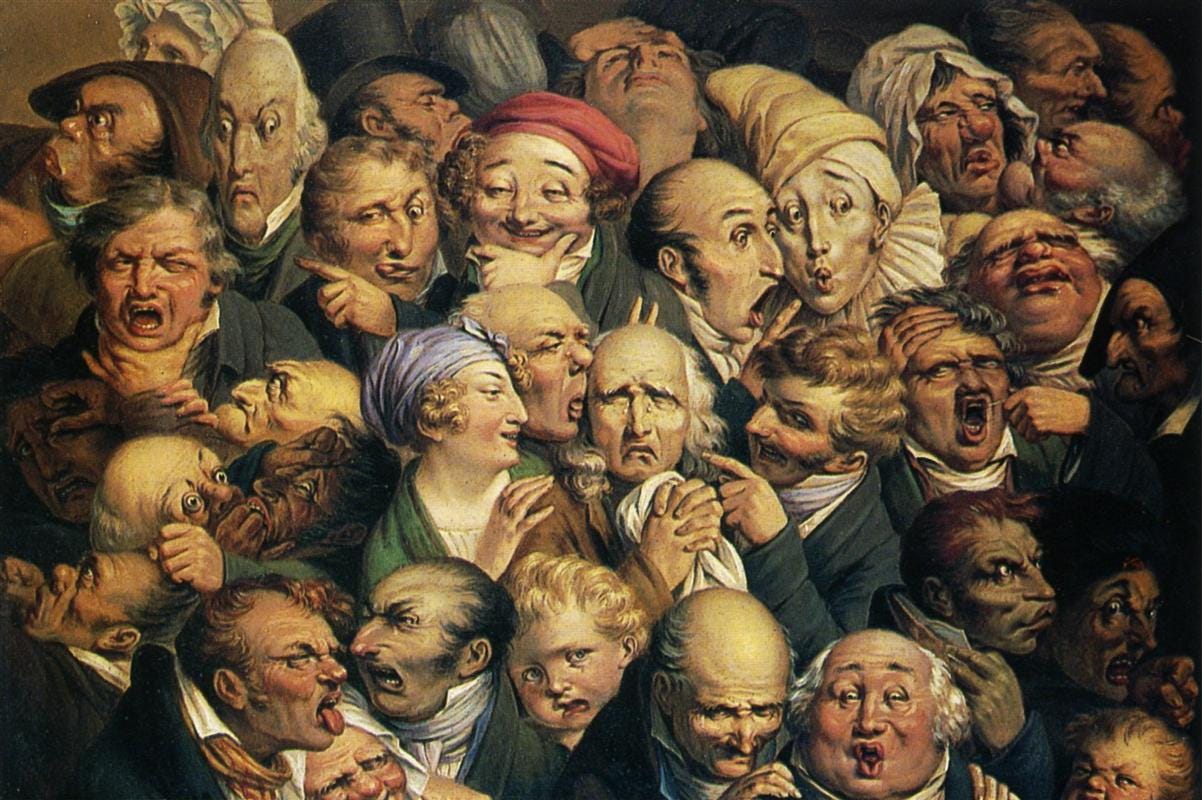
“Laughter always arises from a gaiety of disposition, absolutely incompatible with contempt and indignation.”
— Voltaire, 1736
“You had to be there.”
You’ve heard this phrase before, no doubt.
Perhaps you come across a conversation amid a group of friends already in conversation or you’re in a business meeting and someone tells a funny story (to them) that is lost on you.
The blank stare on your face when others are laughing gives away your outsider status. Perhaps you even manage to utter, “I don’t get it.”
“Oh, you had to be there,” they tell you.
In such cases, context matters. If you missed the original scenario in which the story unfolded, you don’t have the same context as the others.
But there’s something else happening here as well: you’re being excluded. It may not be intentional, but you distinctly feel as if you’re outside the inner circle at the moment.
Researchers have begun to focus on rejection and the associated psychological and physiological reactions. In fact, they discovered that the pain of being excluded is not much different from the pain of physical injury. It can influence emotion, cognition, and even physical health.
Exclusion or rejection can even go beyond the mental well-being of the individual being excluded, spilling over into the environments in which they live or work. In 2003, Duke University psychology researcher Mark Leary, Ph.D. studied 15 cases of school shooters, and found all but two suffered from social rejection. 1
If you’re a leader, you have a responsibility to ensure that when your team is using humor in a business setting, they’re doing it in an inclusive way.
No, not everyone may have been present at that client dinner or sales call where the story unfolds. But you can tell the story in a way to give others necessary information to piece everything together.
“Jests and scoffs do lessen majesty and greatness and should be far from great personages and men of wisdom.”
— Henry Peacham, 1622
For the executive who thinks humor is inappropriate in a place of business, we should dismantle the thinking that serious minds are serious all the time. Through play and mirth, some of the greatest ideas, plans, and relationships are born.
Is it too much to ask that everyone is on board with the humor before we go down that path?
When we are being humorous and sharing our humor with others, we’re being a little vulnerable and authentic. At the intersection of vulnerability and authenticity is trust.
This is part of the wide-ranging discussion we had yesterday with Kathy Klotz-Guest on Timeless Leadership:

Humor is truth.
So you want to know the funny thing that happened to me on the way to this newsletter?
As I launched the livestream of yesterday’s recording of Timeless Leadership, I called it Timeless Wisdom there on Fireside Chat.
That’s right, I forgot the name of my own show.
Now that’s funny.

“The comic man is happy under any fate, and he says funny things at funerals and when the bailiffs are in the house or the hero is waiting to be hanged.” — Jerome K. Jerome
I.
We could all use a lift of spirits these days. You might consider taking a trip to The Happiness Museum in Copenhagen, which looks at brighter feelings in uncertain times. (CNN)
II.
Why bringing humor to work has serious benefits. (The New York Times)
III.
An evidence-based perspective on the benefits and challenges of leader humor: Why We Prefer Humorous Leaders. (Pscyhology Today)

“No man ever distinguished himself who could not bear to be laughed at.” — Maria Edgeworth, 1809
I.
Aside from the silliness of the names in his stories (Barmy Fotheringay-Phipps (pronounced “Fungy-Fipps”), Hildebrand “Tuppy” Glossop, Stanley Featherstonehaugh Ukridge), P.G. Wodehouse had a gift for writing humor and dropping us into the action without losing anything. For example, if you were to open Very Good Jeeves and didn’t know Bertie Wooster, this is all you'd need to know:
“It was the morning of the day on which I was slated to pop down to my Aunt Agatha’s place at Woolam Chersey in the county of Herts for a visit of three solid weeks; and as I seated myself at the breakfast table, I don’t mind confessing that the heart was singularly heavy. We Woosters are men of iron, but beneath my intrepid exterior at that moment there lurked a nameless dread.”
II.
The short story “The Celebrated Jumping Frog of Calaveras County” went viral in 1865 and made Mark Twain famous. He was the basis of his later triumphs, but reading it today, it really isn’t that funny. “What once made bankers in New York and boatmen in Baton Rouge laugh out loud would now at best elicit a halfhearted chuckle from a generous reader. It’s hard to say exactly why.” (Lapham’s Quarterly)
III.
A counterintuitive way to cheer up if you’re down: when happiness is what you crave, try giving it away. (The Atlantic)

“The man who cannot laugh is not only fit for treasons, stratagems, and spoils, but his whole life is already a treason and a stratagem.” ― Thomas Carlyle, 1833

🎧 In The Science of Happiness Episode 90: Why Love Needs Laughter, the show focuses on funny things that can reduce stress, anxiety, and make us feel more connected to others. The guests, who were high school sweethearts, learn how humor can also strengthen relationships.

📚 There’s a mistaken belief in today’s corporate world: that we have to be serious all the time in order to be taken seriously. But the research tells a different story: that humor can be one of the most powerful tools we have for accomplishing serious things. Studies show that humor makes us appear more competent and confident, strengthens relationships, unlocks creativity, and boosts our resilience during difficult times. In Humor, Seriously: Why Humor Is a Secret Weapon in Business and Life, authors Jennifer Aaker and Naomi Bagdonas draw on findings by behavioral scientists, world-class comedians, and inspiring business leaders to reveal how humor works and—more important—how you can use more of it, better.
I hope this lifted your spirits a little today. Want to lift someone else’s? Send them this link to try the Premium version of Timeless & Timely — the one you get — for free for two months:
There’s so much to learn,

“The Pain of Social Rejection,” Monitor on Psychology, 2012, Vol 43, No. 4